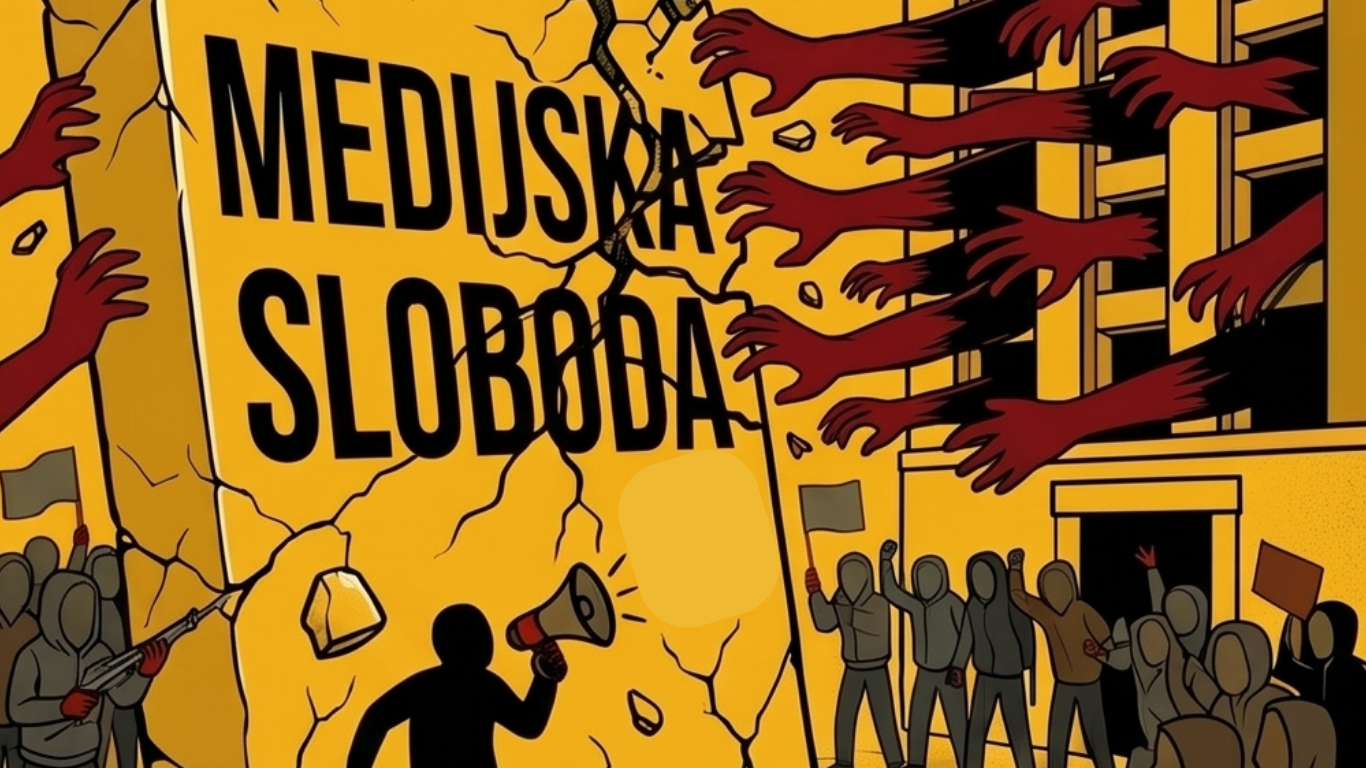
In May, the Independent Journalists’ Association of Serbia (NUNS) recorded a total of eight incidents involving journalists and media workers. Three physical attacks and five cases involving death threats and threats to the physical safety of journalists were documented. Although the number of recorded attacks was lower than in previous months, the threats directed at journalists were exceptionally serious and brutal. Cases of physical obstruction of journalists while reporting from public gatherings were also recorded once again, indicating the continuing risks media professionals face while performing their work in the field.
Serious Threats Against Journalists
The editorial staff of the news portal Mašina became the target of serious threats on social media. In a comment posted under an Instagram post in which the newsroom invited followers to support its work through donations, a user operating under the account name batko67 wrote: “The only thing I’ll donate to you is a bullet in the forehead.” On the same day, after the newsroom informed the public about the threats, several additional disturbing comments were posted, including another threat from a different profile stating: “You’ll end up in a barrel.”
On 18 May, journalist Srđan Nonić received two disturbing messages containing threats and insults through his Facebook page Niška inicijativa (Niš Initiative). One message stated: “You’re a disgusting scumbag. You should be hanged! Filthy piece of trash.” After Nonić replied, “Who are you, hero? Introduce yourself. Do you want to hang me?”, the same profile responded: “Let’s meet. Come on, hero. Get in touch, scumbag.” The same individual subsequently called Nonić, repeating similar insults and disturbing messages and demanding that they meet in person.
SportKlub journalist Nikola Stamenić received threats on 18 May following the publication of the article “Year-End Review 2025: Red Star’s Liabilities Reach €86 Million.” A direct threat was posted in the comments section by a user named Boško: “Nikola Stamenić, I have two sons and a daughter, and I swear on them personally that you will not live much longer because of these provocations and spreading hatred. I will make your life miserable. Take this very seriously. I will gain nothing from this, but my children and future generations who come after us will be able to live at least somewhat happily without lies, tensions, and hatred. People like you, and various Pantićs and Tegeltijas, have no place on this Earth!”
Ana Mihajlovski, former editor of Naš Portal, was subjected to pressure and threats from an individual allegedly connected to the operation of the portal. As a result, she decided to step down from her editorial role and transfer ownership of the outlet. Following her public announcement that she was withdrawing from editorial duties and activities related to the portal, additional threats were made by other individuals.
Obstruction of Journalists While Reporting on Public Events
Several cases of obstruction of journalists while covering public events were recorded during May. On 5 May, during a session of the Municipal Assembly of Kula, where the Assembly President was being elected amid tensions caused by repeated voting and alleged procedural irregularities, an N1 television reporter entered the assembly hall. Despite holding accreditation to cover the event, she was physically removed from the premises shortly afterwards.
On 8 May, journalist Aleksandar Blanuša was physically obstructed and attacked at the Great Market in Zrenjanin during clashes between members of the Serbian Progressive Party (SNS) and activists of the United Phantoms Movement (PUF). Blanuša attempted to obtain a statement from Mayor Simo Salapura but was unable to do so because, according to his account, SNS activists and supporters pushed him, tripped him, and otherwise obstructed him in carrying out his journalistic duties. Activists stood in front of his camera, and at one point SNS officials allegedly attempted to seize his mobile phone. Several hours later, SNS supporters and activists gathered at a nearby roundabout and verbally abused both him and members of his family. Blanuša carried his press identification throughout the incident.
Following a protest held in Belgrade on 23 May, during which clashes occurred between police and a number of citizens, a Zoomer journalist reporting from the scene was pushed by police officers. While filming an intervention in which officers were striking a young man with batons, she was shoved with a police shield despite being clearly identified as a journalist and wearing a press vest.
Judgment Against the Slavko Ćuruvija Foundation Puts Pressure on Freedom of Expression
The Second Basic Court in Belgrade issued a first-instance judgment ordering the Slavko Ćuruvija Foundation (SCF) to pay a total of RSD 1,035,000. The Foundation was ordered to pay each plaintiff RSD 200,000 in compensation for non-material damages related to emotional distress allegedly caused by harm to their honour and reputation, as well as legal costs. Former members of the State Security Service filed the lawsuit against the SCF over a public statement expressing dissatisfaction with the final acquittal issued by the Court of Appeal in the case concerning the murder of journalist Slavko Ćuruvija.
From the outset, concerns were raised that the lawsuit bore the characteristics of a SLAPP (Strategic Lawsuit Against Public Participation) action. However, the court did not take the defence’s arguments into account. It is particularly concerning that the court issued this decision after the Supreme Court had found significant violations of criminal procedure in the Court of Appeal’s acquittal judgment that favoured the defendants—the former State Security officers who later sued the Foundation over its reaction to the acquittal. In addition to the fact that justice has not been achieved in the case of Slavko Ćuruvija’s murder, the judgment constitutes additional pressure on the Foundation for publicly expressing dissatisfaction with the acquittal. Such a decision may have a chilling effect on freedom of expression and reporting on issues of significant public interest, sending a message that organisations and individuals who critically address such matters may become targets of legal proceedings.
The National Working Group for Combating SLAPPs assessed that the judgment represents dangerous pressure on freedom of expression and warned that decisions of this kind directly narrow the space for public debate and encourage the further use of the judiciary as an instrument of pressure.
Potential Sale of Adria News Network Media Threatens Media Freedom
Information regarding the sale of some of the last remaining independent media outlets in Serbia to Alpac Capital represents a direct and inevitable threat to media freedom in Serbia and across the Western Balkans.
Through this transaction, one of the last editorially independent television news broadcasters, daily newspapers, and online media platforms in Serbia would come under the control of a company whose existing media investments have been marked by documented allegations of censorship, political interference, and the erosion of editorial standards.
Alpac Capital, the prospective owner, acquired a majority stake in Euronews in 2022. Following that acquisition, the licence for Euronews Serbia was granted to the state-owned company Telekom Srbija. The company’s CEO was subsequently recorded discussing strategies for weakening N1 television with a senior executive of United Group. The conversation reportedly included a personal request from President Aleksandar Vučić to remove one of the key guarantors of editorial independence from the company.
Investigative reporting by the French outlet Direkt36 and the newspaper Le Monde later revealed that the acquisition had been partially financed through Hungarian state capital and companies closely linked to the political networks of Viktor Orban.