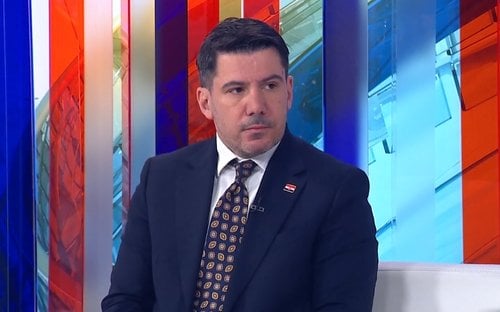
Nikola Grmoja, leader of a parliamentary political party, Member of Parliament and Chair of the Croatian Parliament’s Judiciary Committee, was evidently unsettled by the criticism directed at him by Večernji list journalist Milena Zajović in an editorial commentary.
His reaction was swift. On the very same day, Grmoja effectively painted a target on Milena Zajović’s back by publishing a disgraceful Facebook post aimed, as he put it, at exposing an “activist”, when in reality it was an attempt to discredit a journalist who had dared to criticise his populist style of public communication, Večernji.hr reported.
“Criticise me all you want, but don’t attack my worldview,” Grmoja declared in a subsequent Facebook video, responding to a public statement issued by the Croatian Journalists’ Association (CJA), which had criticised his attempt to dehumanise a journalist.
Grmoja’s understanding of public debate is both dangerous and deeply revealing. In his initial attack, he first sought to undermine Milena Zajović’s professional credibility by describing her as “an activist pretending to be an independent journalist.” He then dehumanised her by referring to “beasts”, and concluded by sending an unmistakably threatening message, speaking about what would happen once “they take responsibility.”
Using the authority of his political office, Grmoja subtly mobilised his supporters, whose violent and hateful comments beneath his post clearly illustrate the audience he is appealing to. Fortunately, this remains only a vocal minority, as reflected in his party’s support, which currently hovers just above the electoral threshold.
If anyone wonders why Grmoja did not respond to the journalist through the pages of the very newspaper in which her commentary was published, as would be expected in a civilised public debate, the answer is straightforward, such a response would not have been published. Not because of malicious censorship, as Grmoja typically claims in his populist rhetoric, indeed, he is one of the most frequent political guests across Večernji list’s media platforms, but because his response contains virtually no coherent arguments, is inflammatory in tone and fundamentally illiterate.
No responsible media outlet publishes such material because, unlike Grmoja, journalists and editors recognise their responsibility toward readers and society. Politicians should likewise understand the power they exercise when addressing the public. Doing so, however, requires both media literacy and a basic level of civility.
Mr Grmoja, by disregarding the principles of civil public discourse and the legal standards governing public communication, you are not contributing to democracy. Instead, you are fuelling social divisions from which you politically benefit, accelerating the erosion of democratic culture and encouraging a climate of disorder. You are fully aware of this, and you continue to exploit it.