Albania’s “Flamingo Revolution” has become one of the country’s most significant civic mobilisations in years, beginning around preparatory works in the Vjosa-Narta protected area that activists denounced as illegal, non-transparent and linked to a tourism and real estate project associated with Jared Kushner’s investment plans. The protests started at the end of May after the site was closed off with barbed-wire fencing amid access-road and pre-construction works, with some protesters injured in clashes with private security, and quickly grew into a wider challenge to opaque decision-making, the strategic investor model, environmental governance and the political establishment.
The media question emerged from this transformation. The protest did not wait for the traditional television agenda to recognise it. In the first days, citizens used phones, live streams, social platforms, independent and local media outlets and freelance journalists to make the event visible. While videos from Zvërnec protest on Saturday 30th May and then in Tirana on Sunday 31st May, dominated social media, much of mainstream audiovisual media stayed silent or framed the project mainly through jobs, economic impact and tourism development, minimizing the protesters’ scale and demands. The mass protests known now as Flamingo Revolution not only received little attention but also later reflected in a one-sided way by major television and national media. Activists interviewed by BIRN said social platforms had become the main channels for information, mobilisation and documentation. Sidorela Vatnikaj described the experience in one sentence: “our only allies are each other.” Besjana Shehu, an environmental activist, added that social media was doing what traditional media should have done from the first day: amplifying the message, voice and presence of the cause.
This is the first important feature of the anti-media discourse: it grew out of a perceived information vacuum. The anger was not primarily directed at journalism as a democratic function. It was directed at a media system seen by protesters as late, selective, aligned with economic and political interests, or willing to reproduce establishment narratives. BiEPAG described the protests as a prism through which systemic weaknesses became visible: private security, opaque legal changes, lack of transparency and a captured media landscape in which disinformation could replace journalism.
As the mobilisation expanded, the information space around it also changed. Citizens.al described a shift from ignoring the protest to delegitimising it. Once the demonstrations became too large to overlook, parts of the public debate moved away from the substance of the demands and toward labels about the protesters’ identity, motives or alleged foreign influence.
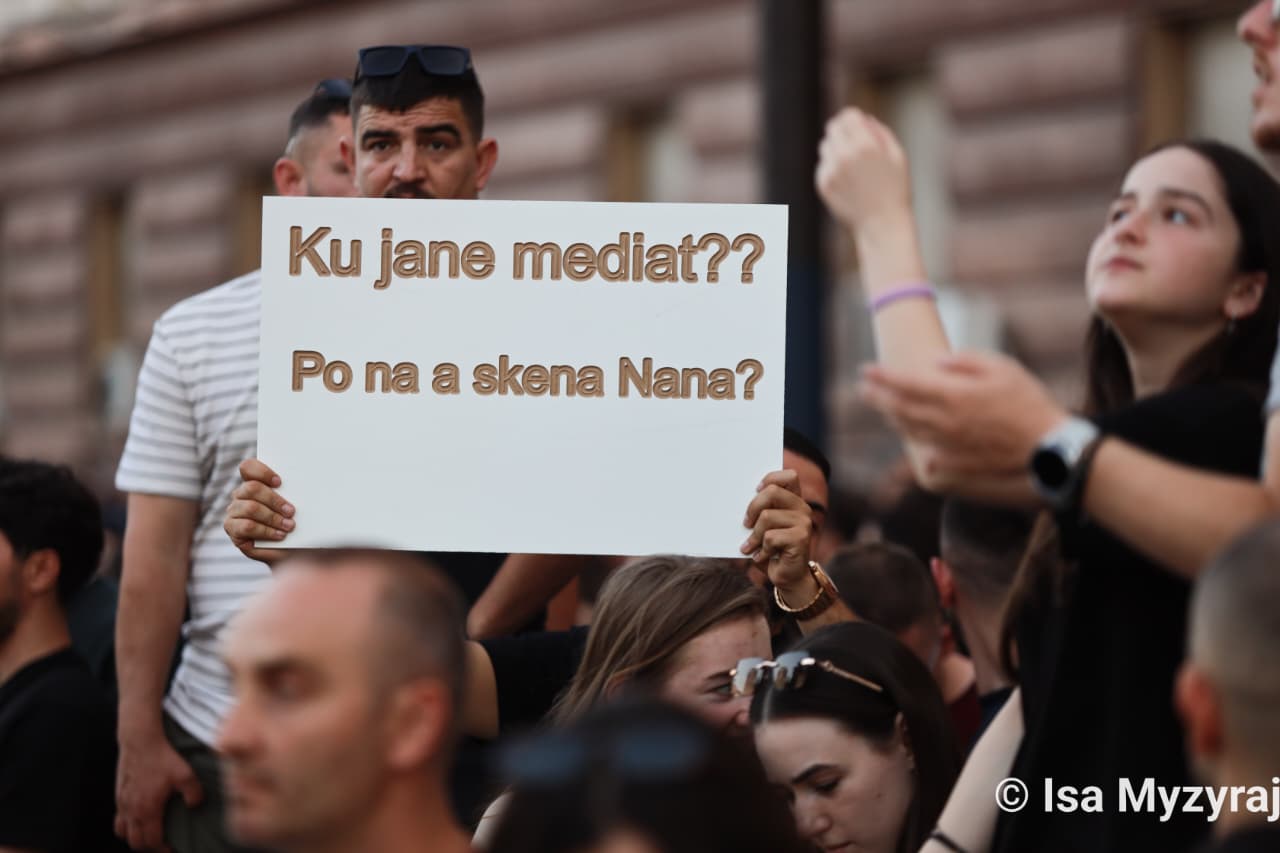
The protest also developed a new language of civic communication. Reporter.al showed how memes, placards and satire moved between the boulevard and social media, turning short, visual messages into political commentary and mobilisation tools. Blerjana Bino told BIRN that “the meme becomes at the same time a placard, a caricature, a political comment and a tool of mobilisation.” This digital-public loop helped the protest bypass traditional gatekeepers and made the flamingo a shared symbol of resistance to opaque governance, public asset capture and political arrogance.
The slogan of the protest: “Bojkotoni mediat!” (Boycott the media!) belongs to this context. It expresses a deep rupture of trust between citizens and parts of mainstream media. It should be read as a reaction to perceived capture, selective reporting, propaganda and delegitimising narratives around a major civic mobilisation. The slogan also reflects a generational and technological shift: younger protesters and civic actors no longer depend only on television studios to document reality, build legitimacy or reach the public. They can produce their own evidence, images, humour, narratives and networks of mobilisation.
For journalists’ safety, however, the same slogan creates a serious boundary problem. Criticism of media ownership, editorial lines, political influence and unprofessional reporting is legitimate in a democratic society. Field reporters, camera operators, photojournalists and freelancers covering a protest are not necessarily responsible for the ownership structure, economic interests or studio framing of the outlet they work for. When anger toward “the media” moves from criticism of structures to hostility toward individual media workers, it can turn a crisis of trust into a safety risk.
That risk was visible enough for the Albanian Association of Journalists to react twice. On 5 June, after journalists reported insults, verbal threats or attempts to obstruct their work, AGSH stressed that journalists are not parties to the protest and are present to document events, inform the public and transmit protesters’ voices to a wider audience. It stated that media criticism is legitimate, but should not turn into hostility toward individual journalists who often work in difficult conditions. On 12 June, AGSH again reacted to placards and messages targeting media, journalists and media workers, underlining that criticism of editorial lines or reporting must not become collective stigma or create a hostile climate. Its clearest line was: “Journalists are not citizens’ opponents.”
The implications are wider than one protest. The Flamingo Revolution exposed a triangular crisis: citizens distrust major media because they perceive them as captured or dependent; journalists in the field carry the consequences of that distrust; and political actors benefit when public debate shifts from the substance of the protest to narratives of foreign influence, manipulation or disorder. A serious response has to hold both realities together: the protest exposed real failures in the media’s democratic function, and journalists still need protection from collective blame in protest spaces.
The lesson for media freedom in Albania is therefore demanding on all sides. Media outlets need to confront the credibility crisis through timely reporting, verification, transparency about interests, clearer separation between reporting and commentary, and more space for affected communities and independent expertise. Protest organisers and participants need to protect journalists and media workers in the field, including when they disagree with the outlet they represent. Public officials and political actors need to avoid narratives that portray protesters, journalists, civil society or critical media as foreign agents or enemies. The Flamingo Revolution did not create Albania’s media trust crisis. It made that crisis impossible to ignore.
Produced by: Blerjana Bino
Photo: Isa Myzyraj