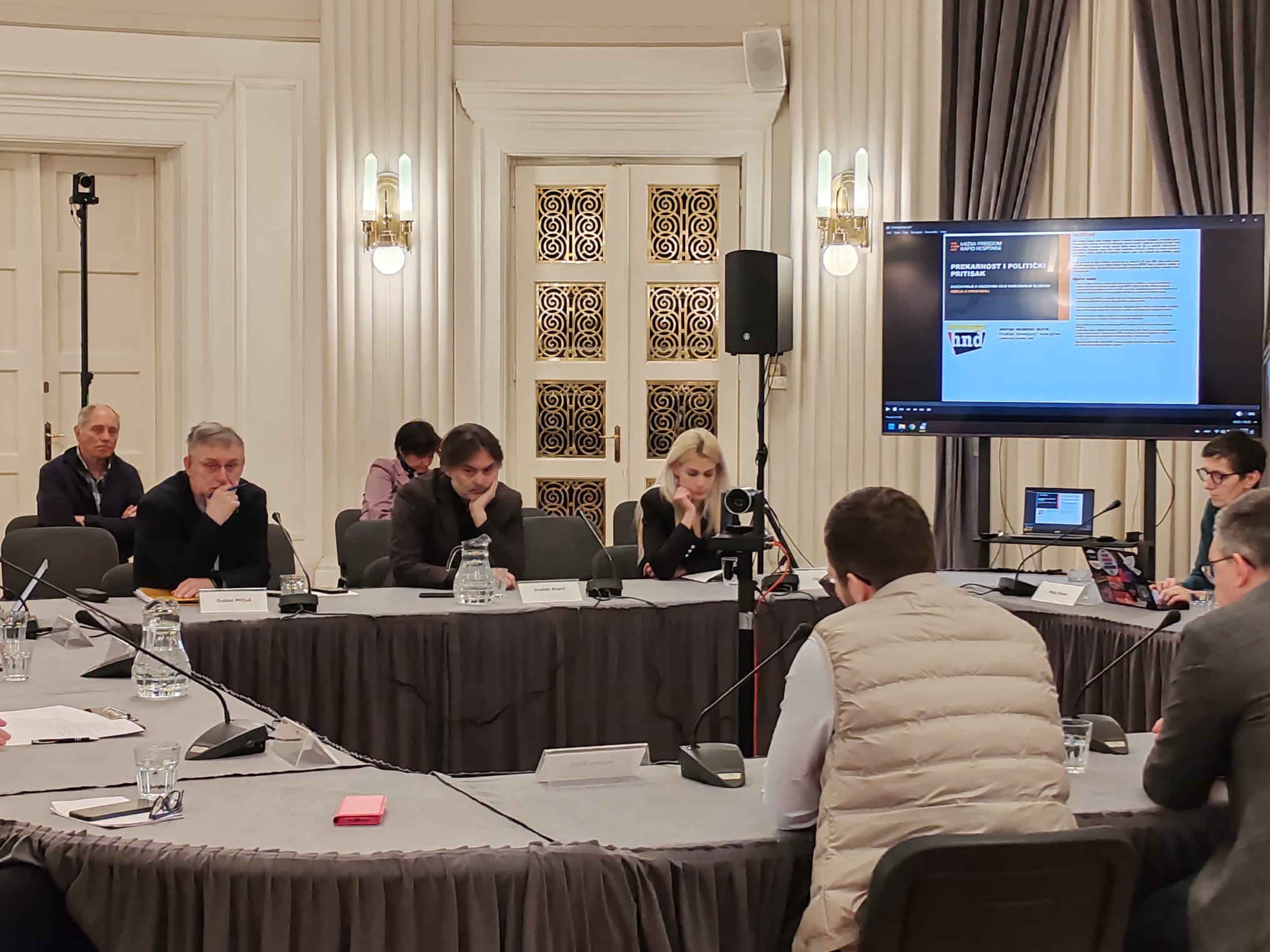
Media freedom in Croatia is being undermined by job insecurity, political pressure, and the government’s reluctance to implement provisions of the European Media Freedom Act (EMFA) into Croatian media legislation, it was emphasized at a roundtable organized by the Croatian Journalists’ Association (HND) on Monday.
Hrvoje Zovko, president of the HND, said the goal of the event was to spark a public debate on the findings of the Media Freedom Rapid Response (MFRR) international mission regarding the state of media freedom in Croatia, as well as on key issues affecting the journalism profession. These include the Media Act, the transposition of the European Media Freedom Act provisions, implementation of the Anti-SLAPP Directive, and the survival of print media and their distribution.
He also pointed out that the absence of representatives from the Ministry of Culture and Media — who were invited to the HND event — highlights the government’s disregard for the media sector and journalism as a public good.
“The government has not made any effort to address what we have been demanding for years. It speaks volumes that the Media Department within the Ministry of Culture and Media is now reduced to a single person. The reality is that the media sector and journalistic community are facing serious problems, and we have not received a single response to any of our emails from the Ministry,” Zovko said.
Maja Sever, president of the European Federation of Journalists and the Croatian Journalists’ Union, warned about the existential threats facing journalists, referring to recent layoffs at N1 television. She also highlighted the lack of political will to pass new media legislation and implement the Anti-SLAPP Directive and the Media Freedom Act.
“I have no optimism regarding EMFA and the other legislative frameworks. We have no idea when all of this will be implemented into the Croatian legal system. The minister keeps telling us it’s just a technical matter,” Sever said. She also reminded the audience of the extremely tight deadlines for EMFA implementation, particularly amendments to the Croatian Radiotelevision Act (HRT Act) that should be in place by early August. “Even for that, there is no political will,” Sever added.
Urša Raukar-Gamulin, vice-chair of the Croatian Parliament’s Committee on Information, Informatization and Media, warned about political influence in appointing the director of HRT and members of the Electronic Media Council (VEM), the Croatian media regulator. She also criticized the silence of responsible institutions regarding state advertising in the media and the lack of transparency in media ownership.
“Unfortunately, what we are all talking about is not a topic in Parliament. The Media Act and the HRT Act are not topics of parliamentary debate,” Raukar-Gamulin said.
Josip Popovac, director of the Agency for Electronic Media (AEM) and chairman of the Electronic Media Council, said that a key achievement of EMFA is finally drawing a clear distinction between media outlets and communication channels such as social networks. He also noted that the process for selecting members of media regulatory bodies in most European countries is similar to the Croatian model. He concluded by saying the Croatian media sector is “still resilient enough.”
Among those who participated in the discussion on SLAPP lawsuits, newsroom statutes, and newspaper distribution were editors-in-chief Dražen Klarić (Večernji list) and Ivan Buča (24sata), Jelena Pavić Valentić, editor-in-chief of the Telegram portal, Jutarnji list journalist Dušan Miljuš, Dražen Majiš, editor-in-chief of Istra24, as well as media experts Paško Bilić from the Institute for Development and International Relations (IMRO) and Helena Popović from the Faculty of Humanities and Social Sciences in Zagreb.