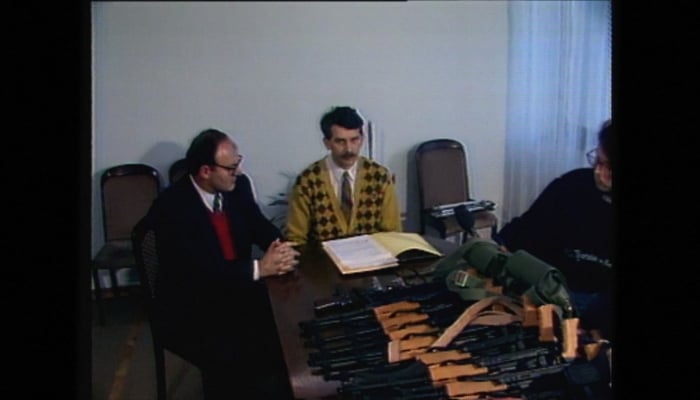
Following the broadcast of the documentary film “The Peacemaker” produced by Factum on Croatian Television (HTV), another wave of attacks targeted the authors Drago Hedl, Hrvoje Zovko, Ivan Ramljak, and producer Nenad Puhovski. The film has received multiple awards at prestigious international festivals as well as in Croatia, where, among other honours, it won the Grand Golden Arena for Best Film at the Pula Film Festival.
The Initiative for Croatia of Freedom issued a press release titled Peace to the “Peacemaker”, highlighting that after the documentary “The Peacemaker” was aired on Croatian Television (HTV) on Thursday, yet another campaign was launched against its authors. They point out as problematic the way the public broadcaster organised a debate with historian Ante Nazor, inviting him to evaluate an artistic work — something they do not do when other films of similar themes are concerned. We publish the statement in full:
Following the broadcast of the documentary film “The Peacemaker” produced by Factum on Croatian Television (HTV), another wave of attacks targeted the authors Drago Hedl, Hrvoje Zovko, Ivan Ramljak, and producer Nenad Puhovski. The film has received multiple awards at prestigious international festivals as well as in Croatia, where, among other honours, it won the Grand Golden Arena for Best Film at the Pula Film Festival.
“The Peacemaker” tells the story of Josip Reihl-Kir, the Osijek police chief killed at the entrance to Tenja in 1991 — a story that the widest audience has now finally been able to see. The entire film is based on court-established facts, testimonies of witnesses of the time, and authentic audiovisual material. We once again congratulate the authors on the film and welcome its timely broadcast, which, unfortunately, has been accompanied by another wave of attacks on culture due to differing interpretations of wartime events.
Comments by historian Ante Nazor, such as “if a film relies on archival material, then it must be presented in its entirety and not selectively,” encroach upon the artistic freedom of the authors. Nazor continues by stating that “…we end up with a work that does not contribute to understanding history but deepens divisions.” We believe that Nazor himself, by positioning himself as the authoritative figure who determines whose interpretation is complete and whose is not, is fuelling tensions, suggesting that only the Croatian Memorial-Documentation Centre of the Homeland War may offer a canonical interpretation of wartime events.
Through his appearances on television, he opens space for attacks that flood social media, calling into question the integrity of the authors and the funding of the Croatian Audiovisual Centre (HAVC). Also problematic is the way the public broadcaster HTV organised a debate with Nazor, inviting him to assess an artistic work — something they do not do with other films of similar subject matter. The public media service too often shows whose side it is on and whom it distrusts. This creates an atmosphere of mistrust and even an a priori suspicion toward future works that question events of the 1990s. In this way, the creative potential of Croatian authors is indirectly silenced by denying them the right to their own interpretation of historical events.
The Initiative for Croatia of Freedom (ZHS) reminds that by belittling this work and its authors and producer, all state institutions that recognised and supported the film during its development and production are also being undermined, as is the collective public effort to enable, in conditions scarce for culture, the creation of what is most valuable — cultural heritage and future legacy. Debates and polemics are hallmarks of an open society, which the ZHS Initiative advocates, but not when one polemicist positions himself as the sole legitimate authority and interpreter of the past, belittling the film as a work of art as well as the role of the peacemaker, the Osijek police chief Josip Reihl-Kir, who was killed in an ambush.
We call for peace for the authors of The Peacemaker and for respect of the principles of pluralism and the right to civic and cultural freedoms. If anyone sees a problem in the alleged neglect of certain documents, they are free to present a different interpretation through publications and new audiovisual works.