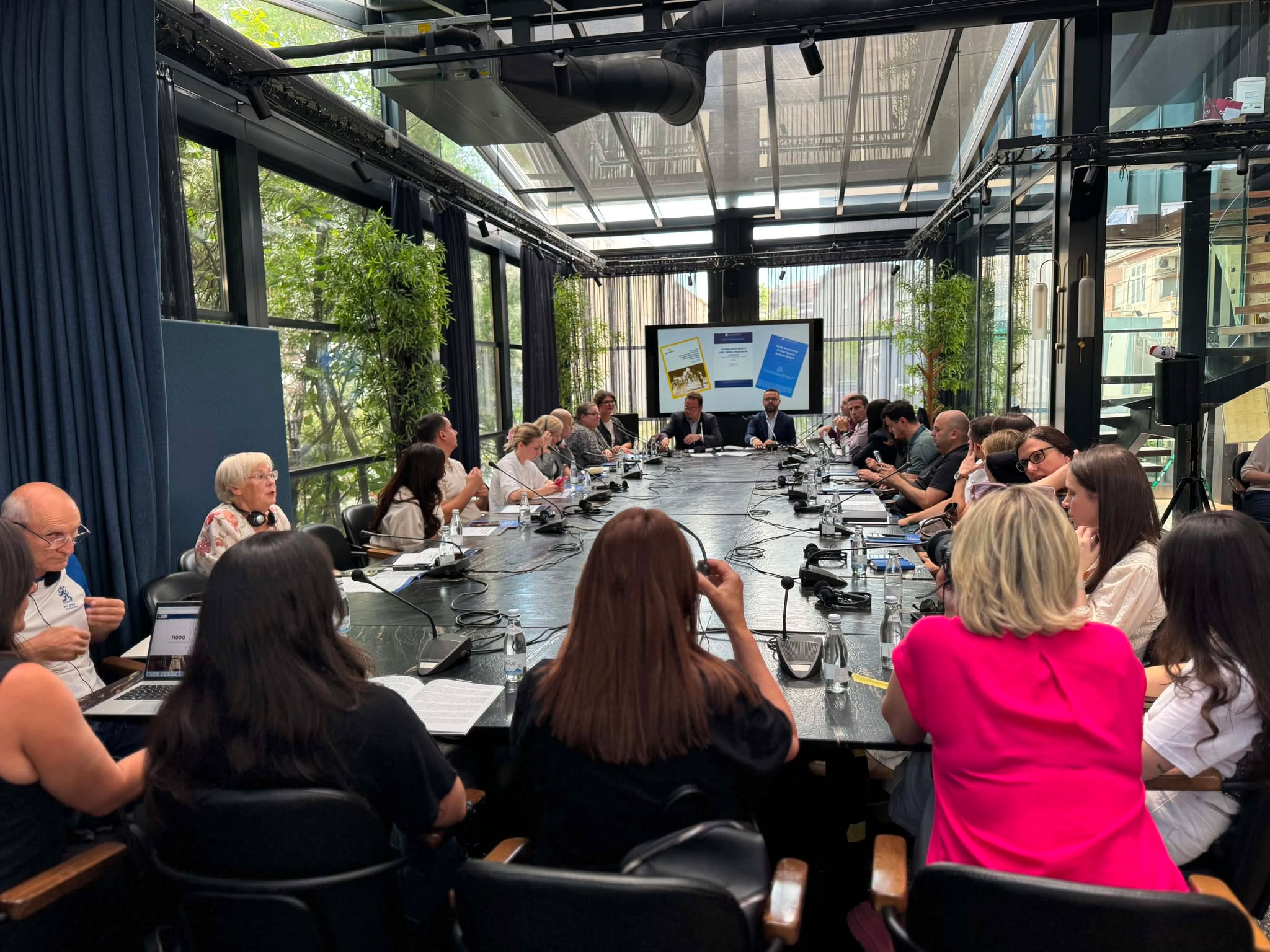
Today, three new reports were published addressing media freedom, journalists’ safety, and hate speech in Kosovo’s media space. These reports provide a detailed overview of developments in recent years and the current challenges facing journalism in the country.
The opening remarks were delivered by Xhemajl Rexha, Chair of the Board of the Association of Journalists of Kosovo (AGK), who stated that “these reports show, through statistics and real developments, the situations journalists in Kosovo are facing, including ongoing online attacks that very often come from politics, as well as real physical attacks resulting from an increasingly difficult environment for practicing journalism. The reports’ recommendations call on actors who obstruct journalists’ work to stop these practices, and on judicial institutions to prioritize these attacks.”
Jerome Bouyjou, Head of Human Rights at UNMIK and Representative of the UN High Commissioner for Human Rights in Kosovo, emphasized the importance of these reports in understanding trends in freedom of expression and media freedom in Kosovo. He called for swift investigations into attacks on journalists and for stronger commitment to protecting media freedom, journalists’ safety, and human rights.
1. Indicators of Media Freedom and Journalists’ Safety Index 2025
The report, presented by Getoarbë Mulliqi and Yll Zekaj, highlights a clear contrast between the legal framework and practical reality in Kosovo.
Kosovo has a relatively advanced legal framework guaranteeing freedom of expression and protection of journalists, including the decriminalization of defamation and regulation of access to public documents. However, the main issue remains weak enforcement of laws and lack of institutional efficiency.
Key challenges include:
- delays in access to public information
- political influence over regulatory institutions
- weak accountability mechanisms
- lack of protection against abusive lawsuits (SLAPPs)
- political and economic pressure on media
The report also highlights that journalists work in unsafe conditions, with unstable contracts and continuous pressure from political and other actors.
In terms of safety, the year 2025 recorded 69 cases of attacks against journalists, along with an increase in hate speech and delegitimizing rhetoric from public and political figures.
Report link in three languages:
https://agk-ks.org/publikime/treguesit-e-nivelit-te-lirise-se-mediave-dhe-indeksi-i-sigurise-se-gazetareve-2025/
2. Media Monitoring and Hate Speech Report (March–May 2026)
This report, presented by Professor Jeton Mehmeti, analyzes 138 cases of hate speech and harmful discourse in media and social networks.
Key findings show that:
- 71.7% of cases involve hostile and polarizing political discourse, where political opponents are often portrayed as “traitors,” “enemies,” or “national threats.”
- 77.5% of cases originate from Albanian-language media, while 22.5% come from Serbian-language media.
A significant portion of the content does not constitute direct hate speech but rather forms of stigmatization, delegitimization, and demonization, which are then amplified through social networks.
The report also highlights:
- increasing rhetoric against journalists
- use of conspiracy narratives
- strong influence of digital platforms on polarization
Report link in three languages:
https://agk-ks.org/publikime/raporti-i-monitorimit-te-medias-dhe-gjuhes-se-urrejtjes-2026/
3. Safety of Journalists and Media Freedom in Kosovo (2021–2026)
This report, presented by Burbuqe Kastrati from the FOL Movement, analyzes long-term trends in journalists’ safety and shows a persistently concerning situation.
Key findings:
- 2021: 18 cases
- 2022: 20 cases
- 2023: 33 cases
- 2024: 26 cases
- 2025: 9 cases
- January–May 2026: 9 cases
The report shows that attacks on journalists continue in a consistent pattern and include:
- physical assaults
- direct threats
- obstruction of journalistic work
- online campaigns and hate speech
- gender-based attacks against women journalists
Several serious cases of pressure and threats against investigative journalists and field media teams are also noted.
Another highlighted issue is the lack of effective legal follow-up, with only a small number of cases resulting in indictments.
Journalists’ safety remains a systemic issue that directly affects media freedom and citizens’ right to information.
Report link in three languages:
https://agk-ks.org/publikime/siguria-e-gazetareve-dhe-liria-e-medias-ne-kosove-janar-maj-2026/