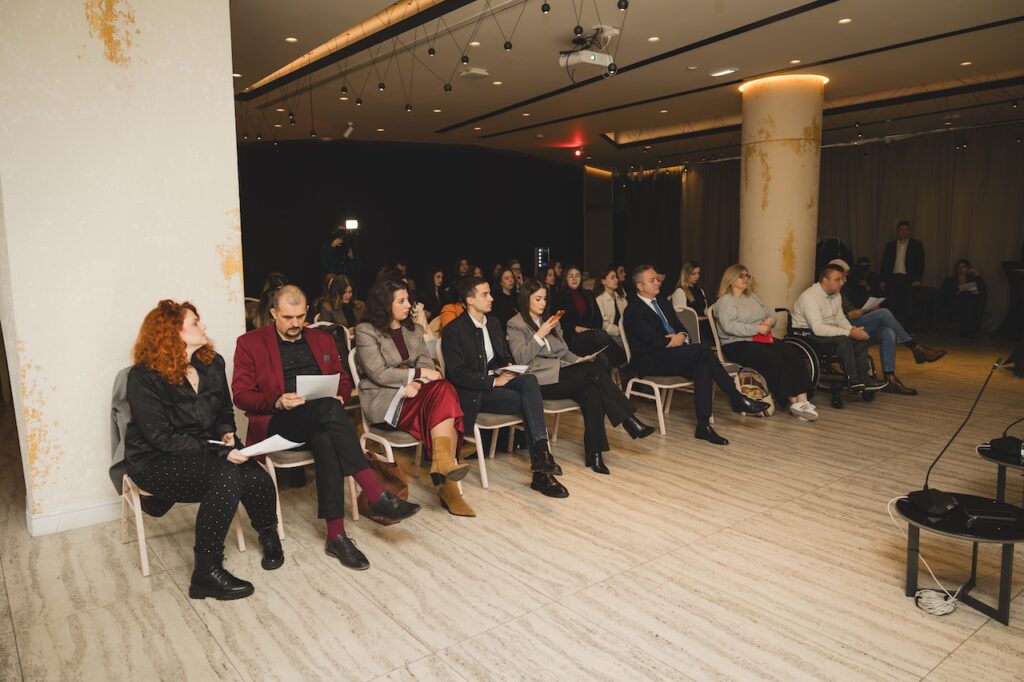
PODGORICA, 17.12.2025 – Hate speech often does not appear in the media content itself but escalates in the comments. It is most frequently based on national affiliation and directed at minorities, indicating that identity-related issues, along with associated historical narratives and political contexts, are powerful tools for raising tensions, while multiculturalism is endangered. It is therefore important for the media to contribute not only through responsible reporting but also through careful and committed moderation of comments, as highlighted today at the “The Digital Face of a Multicultural Society” event organized by the Center for Civic Education (CGO).
“One of the Ministry of Human and Minority Rights’ priorities is cooperation with the NGO sector to improve the rights of minority peoples and other national communities in Montenegro. The Directorate for the Promotion and Protection of the Rights of Minority Peoples and Other National Communities has allocated €400,000 this year for NGO projects in this field, supporting initiatives from 21 organizations,” said Arben Xhurreta, Acting Director General of the Directorate, opening the event. Xhurreta described Montenegro as an example of peaceful coexistence in the Balkans and a valuable experience for the wider community, while noting that it must be nurtured. “Coexistence of all citizens, regardless of their cultural, linguistic, religious, or other characteristics, represents the only sustainable alternative, deeply rooted in the centuries-old traditions of Montenegrins and all those living in this small but proud country,” Xhurreta emphasized.
“Multiculturalism in Montenegro today is under serious strain. Instead of a space for shared life and mutual understanding, we are witnessing growing divisions, in which anything different—whether opinion, identity, or behavior—is perceived as a threat or even hostility,” said Petar Đukanović, CGO’s Program Director. He stressed that multiculturalism is systematically endangered, noting that institutions cannot simultaneously claim to defend multicultural values while tolerating hate speech, historical revisionism, and clerical pressures. He also highlighted troubling trends among young people, for whom identity increasingly becomes a criterion for acceptance, while diversity is seen as a problem. “This is particularly evident in the digital space, where hate speech has become commonplace, spreads quickly, and is rarely sanctioned. Defending multiculturalism is therefore unimaginable without the development of digital citizenship. It is our responsibility not to remain silent and to use digital spaces for dialogue, solidarity, and community, while institutions must consistently enforce the law, protect the secular order, and invest in education that fosters tolerance and critical thinking,” Đukanović concluded.
The main findings of a two-month monitoring of comments on social networks and portals were presented by Nikola Đurašević, CGO Program Associate, and Jelena Jovanović, Senior Media Analyst at the Arhimed Agency.
“The study was conducted from 10 September to 10 November 2025 and analyzed a total of 1,217 media posts from the most visited portals—Vijesti, Borba, CdM, Portal Analitika, Dan, Antena M, and RTCG. The number of posts analyzed was not evenly distributed across portals, as it depended on editorial policies, current topics, and content type. Of the total posts, 67 contained hate speech, unevenly distributed across the portals,” Jovanović explained, emphasizing that although this represents only about 6% of the sample, it is extremely concerning because this is a phenomenon that requires zero tolerance and clear regulation in the media space. She added that the monitoring also focused on comments on social media and portals to understand dominant narratives and communication patterns in the digital public sphere.
“Within the 1,217 analyzed posts, a total of 12,969 comments were recorded, showing a high level of user interaction with media content, particularly during a period marked by events associated with increased hate speech. Hate speech was present in the comments of 498 media posts across all monitored outlets, accounting for 22% of the total analyzed posts. The cumulative number of comments containing elements of hate speech reached 1,667, or 13% of all recorded comments,” Nikola Đurašević from CGO reported.
Using examples of sports-related comments from portals, Đurašević pointed out that the most direct and dangerous forms of hate speech often appear in user comments on content related to Bosniaks, Albanians, and Croats from Boka, as well as politically and religiously sensitive topics such as diaspora rights, monuments, churches, and religious holidays. “The analyzed comments reflect a wide spectrum of hate speech—from ethnic denigration and calls for violence or expulsion to historical and genocidal narratives, as well as delegitimization of minorities as full citizens of Montenegro. Hate speech often does not appear in the media content itself but escalates in comments directed at minority groups, indicating that it is primarily linked to broader identity tensions, historical narratives, and political context, rather than the news item itself. Of particular concern is the normalization of such language, as it deepens social divisions and legitimizes violence,” Đurašević explained.
Monitoring of social media on these portals revealed significant differences both between platforms and between media outlets. “On Instagram, hate speech was rarely recorded, partly due to selective content sharing by media outlets and stricter platform moderation rules. Users also generally engage less in political and identity debates on Instagram, with only 86 flagged comments recorded. In contrast, Facebook showed the highest concentration of hate speech, often with a lack of active moderation. A total of 718 comments with problematic content were recorded on that platform,” Đurašević noted.
Recommendations focus on three key levels of action. “Media outlets are encouraged to actively and consistently moderate comments, implement clear commenting rules, require user registration, and adopt a more careful editorial approach when transmitting controversial statements. These measures do not constitute censorship but responsible risk management. Institutions should strengthen capacities for monitoring compliance with the Media Law, sanction systemic failure to remove hate speech, and consider introducing the criminal offense of ‘aggravated hate speech.’ NGOs and the academic community play an important role through education, strengthening media and digital literacy, developing counter-narratives, and fostering public dialogue on identity and reconciliation,” Đurašević concluded.
The event brought together over 40 representatives from institutions, NGOs, academia, and media, and was organized as part of the project “Online Together – Against Hate for Multiculturalism,” financially supported by the Ministry of Human and Minority Rights.
Source: CGO