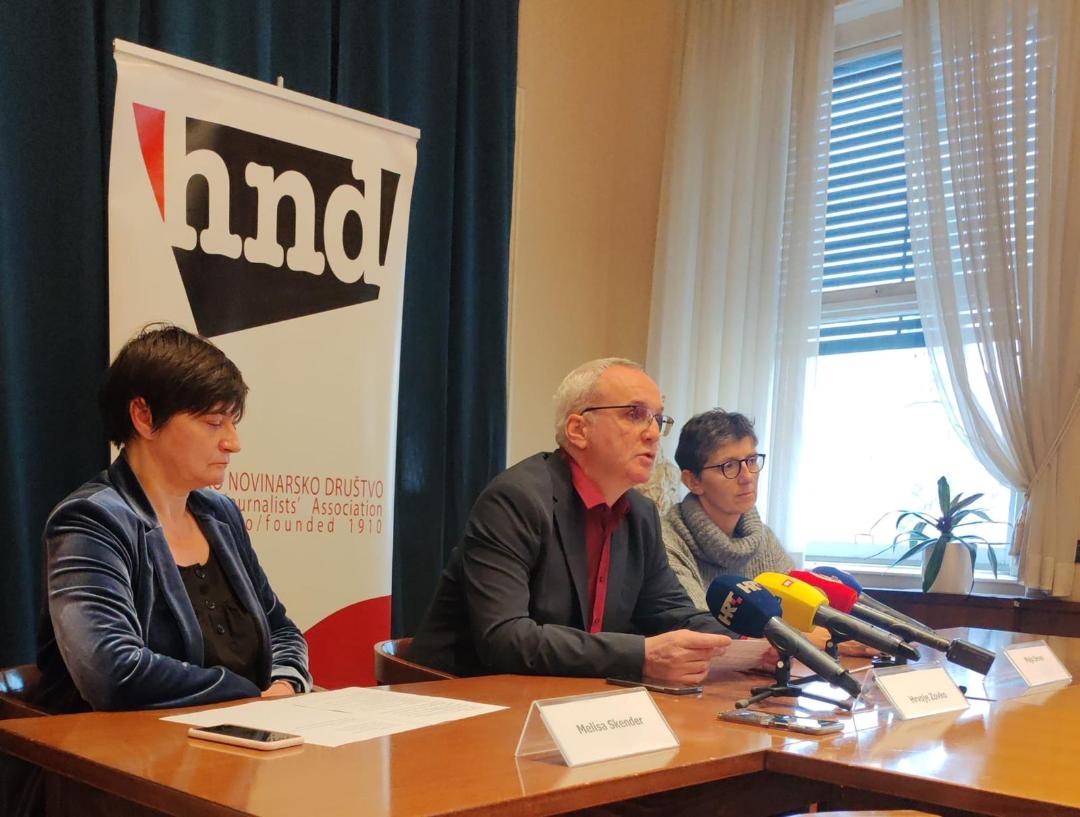
The Croatian Journalists’ Association (CJA) is ending cooperation with the Ministry of Justice and institutions dealing with SLAPP lawsuits, because since Damir Habijan took charge of the ministry, there has been complete ignorance towards CJA, said CJA president Hrvoje Zovko at a press conference held at the Journalists’ House in Zagreb. At the conference, dismal results of a report on the state of media freedom in Croatia conducted by the international Media Freedom Rapid Response (MFRR) mission were also presented. Meanwhile, very interestingly, after the press conference, and following an apology to CJA for sending an email to the wrong address, the Ministry of Justice sent, this time to the correct email, an “Invitation to appoint representatives to the working group for drafting the proposal of the law on the protection of persons involved in public action.”
Zovko explained that the trigger for this decision was the formation of a Working Group on SLAPP lawsuits, to which CJA was neither invited nor informed of its existence, and about which nothing is known regarding its members or working procedures.
“We wrote and requested explanations but received no response. Therefore, we decided not to waste time on fruitless talks. We demand to be respected as a partner. It is unclear to us how someone can establish such a working group without involving someone like CJA, which raised this issue to a high-level problem faced by journalists and media in Croatia. We are always ready for dialogue, but we will not recognize any decisions or acts made without us,” said Zovko. He also noted it is symptomatic that the Ministry of Justice did not join or sign, together with CJA, TUCJ (Trade Union of Croatian Journalists’), and the Ministry of the Interior, the agreement and protocols on the protection of media workers.
Zovko further stated that they are demanding from the Ministry of Culture and Media that CJA be included in the working group on press distribution.
“We are fed up with the ignorance of state bodies and want to participate in all activities concerning the protection of jobs and the profession. If our demands are not met, we will consider ending cooperation with our sectoral Ministry of Culture and Media as well,” said Zovko, who also questioned where Croatia Post disappeared from the talks, since it had been discussed as a possible press distributor.
“We will certainly support an optimal solution for press distribution for the benefit of everyone, but primarily journalists and employees. We think it is not good if a monopolist emerges who, after a year or two, says they will no longer do it and again causes problems for print media,” Zovko emphasized.
CJA Secretary-General Melisa Skender spoke about the report by the international Media Freedom Rapid Response (MFRR) mission on the state of media freedom in Croatia, highlighting that the Croatian media space faces issues such as outdated media legislation with problematic provisions, compromised independence of HRT (Croatian Radio Television), high frequency of SLAPP lawsuits, economic and political pressures, numerous verbal attacks on journalists from top state officials, and difficult access to information.
“Media freedom in Croatia is undermined by institutional and legal challenges that successive governments have failed to address, with the key issue being the Media Law, which has largely remained unchanged since its enactment in 2004. The current Croatian legislation does not comply with several provisions of the European Media Freedom Act (EMFA), especially regarding the independence of the public media service, transparency of media ownership, editorial independence, and the practice of state advertising,” said Skender, adding that state companies are the largest advertisers.
“The report identifies direct political interference by state institutions in managing HRT by politicizing the appointment process of governing bodies through a simple majority vote in the Croatian Parliament. The MFRR report also highlights the lack of political independence of the regulatory body for electronic media, the Electronic Media Council (VEM), whose members are appointed on the government’s proposal by a simple majority in Parliament for an unlimited number of terms. The absence of rules for the distribution of state funds enables the government to financially reward media outlets that support its policies and punish critical media, encouraging media dependence and undermining journalistic independence,” Skender explained.
The report also states that journalists in Croatia face significant political pressure, especially at the local level, along with increasing incidents of verbal and physical abuse, defamatory campaigns, and economic difficulties. Government representatives, including high officials such as Prime Minister Andrej Plenković, have used public platforms to discredit critical media such as N1, Telegram, Nacional, 24sata, and Index. Such an environment encourages censorship and restricts access to vital public information, along with poor implementation of the Law on the Right to Access Information, undermining journalists’ ability to investigate and report effectively.
The report offers detailed recommendations for key decision-makers in Croatia, outlining a plan to address media freedom restrictions and initiate necessary reforms.
President of the European Federation of Journalists and the Trade Union of Croatian Journalists’ Maja Sever also emphasized that the report is catastrophic for Croatia and commented on the unflattering position of journalism in society, but despite that, “we defend professional and quality journalism.”
Sever stressed the need for joint work in defending the public service and warned about the inadequacy of the HRT Consolidation Plan.
“That plan is full of phrases and listings, without an idea or vision of what the public media service should look like. We urgently need a new HRT Law and must establish quality and transparent communication,” said Sever, adding that a strong, sustainable social dialogue is also necessary. Sever also pointed out the oddity that Croatian decision-makers actively participate in Brussels bodies where media acts and laws are discussed and supported, but when they return to Croatia, there is complete ignorance toward those of us working in professional associations who are also active internationally in this regard.