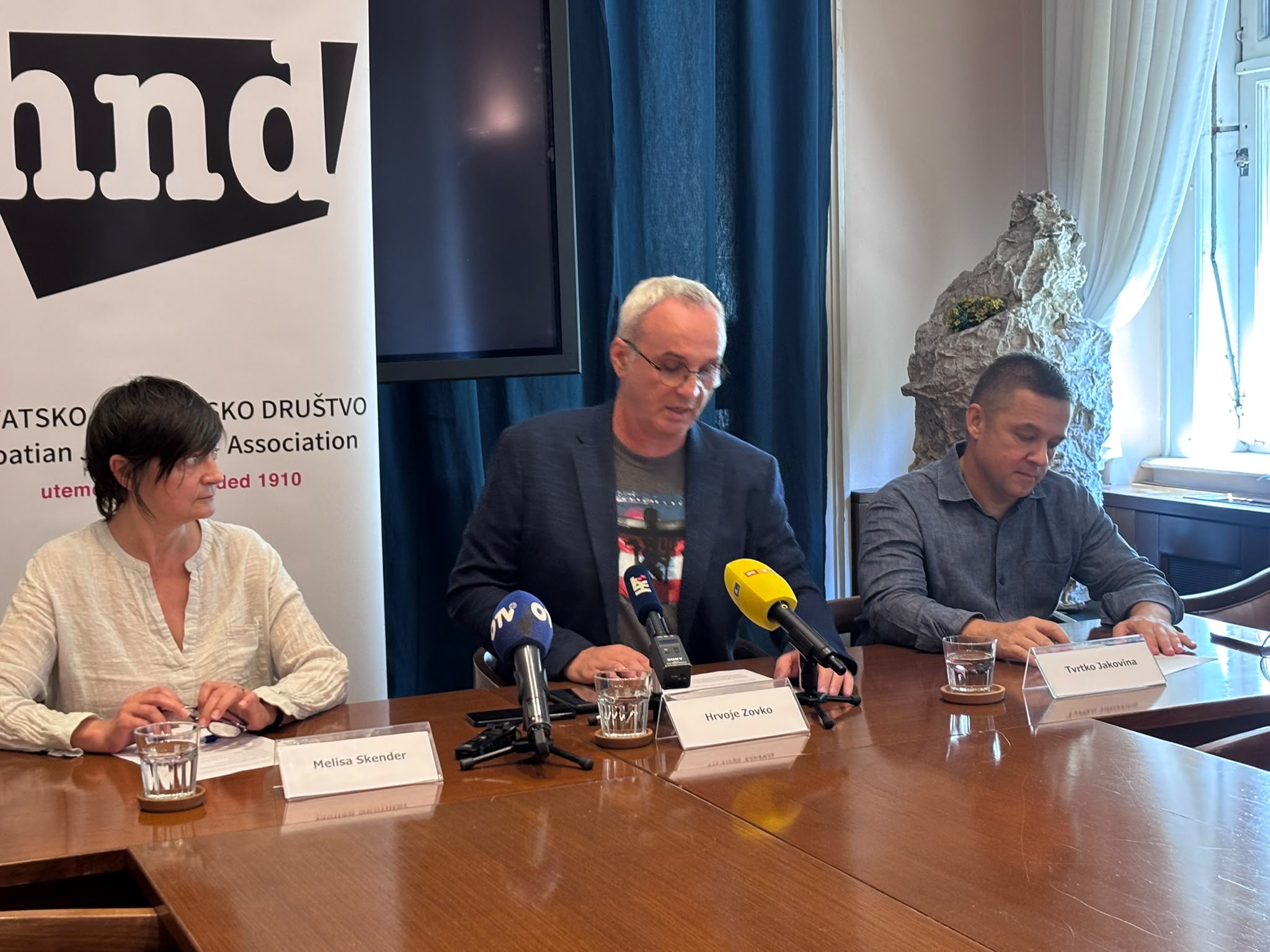
The Croatian Journalists’ Association (CJA) calls on the Ministry of Justice, Public Administration and Digital Transformation to finally decriminalise offences against honour and reputation as part of the announced amendments to the Criminal Code.
At a press conference held today in Zagreb, CJA President Hrvoje Zovko highlighted what he described as the greatest shortcoming of the Act on the Protection of Persons Engaged in Public Participation (the Anti-SLAPP Act): the fact that the deterrent measures provided by the law do not apply to criminal proceedings.
“In Croatia, journalists face dual legal liability for their published work – civil and criminal. Since this Act does not apply to criminal proceedings, we have legitimate concerns that it will lead to an increase in criminal prosecutions against journalists and editors. We therefore call on the Ministry to remove the provisions on criminal offences against honour and reputation from the Criminal Code,” Zovko said.
As an example, he referred to the criminal proceedings initiated by former Croatian Radiotelevision (HRT) Director-General Kazimir Bačić against journalists Branko Mijić and Goran Gazdek, which have now been ongoing for six years. The case concerns a CJA press release that the two journalists signed in their capacity as the Association’s vice-presidents at the time.
In response to the large number of lawsuits against journalists, the CJA established the Centre for the Protection of Freedom of Expression in 2015. The Centre provides free legal assistance to journalists facing lawsuits because of their professional work. Even at that time, the Centre’s legal experts drafted recommendations on handling lawsuits against journalists and media outlets, with one of the key recommendations being the decriminalisation of offences against honour and reputation.
The problem of SLAPP lawsuits is therefore not new, although the concept itself has only recently entered the Croatian legal framework. Among the thousands of lawsuits filed each year, as shown by the CJA’s annual survey on lawsuits against journalists and media, legal experts from the Miko Tripalo Centre for Democracy and Law analysed court decisions in such cases covering the period from 2016 to 2023.
“The analysis showed that during this period there were, on average, around 60 lawsuits per year containing at least one element of a SLAPP lawsuit,” said Tvrtko Jakovina, President of the Governing Board of the Miko Tripalo Centre, noting that the research covered only lawsuits against journalists and media outlets.
“If lawsuits against environmental organisations, activists and whistleblowers were also included, the number would certainly be significantly higher. The same research also showed that court proceedings in these cases last an average of four years, while the compensation claims are very high,” Jakovina added.
CJA Secretary General Melisa Skender stressed that SLAPP lawsuits are not only a problem for journalists but also for many other civil society organisations. She recalled that the CJA was admitted to the working group drafting the Anti-SLAPP Act only after publicly warning that it would suspend all cooperation with the Ministry of Justice unless it was granted representation in the group.
“I have to point out that we were the only representatives of those most frequently targeted by SLAPP lawsuits. We advocated for a definition of SLAPP in line with the indicators set out in the Council of Europe recommendations. That proposal was rejected several times on the grounds that the definition contained in the European Anti-SLAPP Directive was sufficient to identify manifestly unfounded claims. How the courts will apply this definition, and how effectively they will use it for early dismissal and other deterrent measures, remains to be seen,” Skender said.
She announced that the CJA, together with its partner organisations – the Miko Tripalo Centre and the Human Rights House Zagreb, which form the core of the informal Catalyst Network – will closely monitor the implementation of the law in judicial practice.
Skender also reminded the public that journalists, along with numerous civil society organisations and individuals, continue to face serial litigants whose primary aim is to intimidate anyone who critically scrutinises those in positions of power.
CJA President Hrvoje Zovko further noted that, over the past five years, Croatia has produced three European “champions” in receiving the infamous award for the biggest SLAPP litigants: Croatian Radiotelevision (HRT), Judge Zvonko Vrban, and this year’s “winner”, Judge Ivan Marković.