Montenegro’s parliamentary Administrative Committee has proposed new candidates for the governing bodies of the country’s key media institutions — Radio and Television of Montenegro (RTCG) and the Agency for Audiovisual Media Services (AVMS).
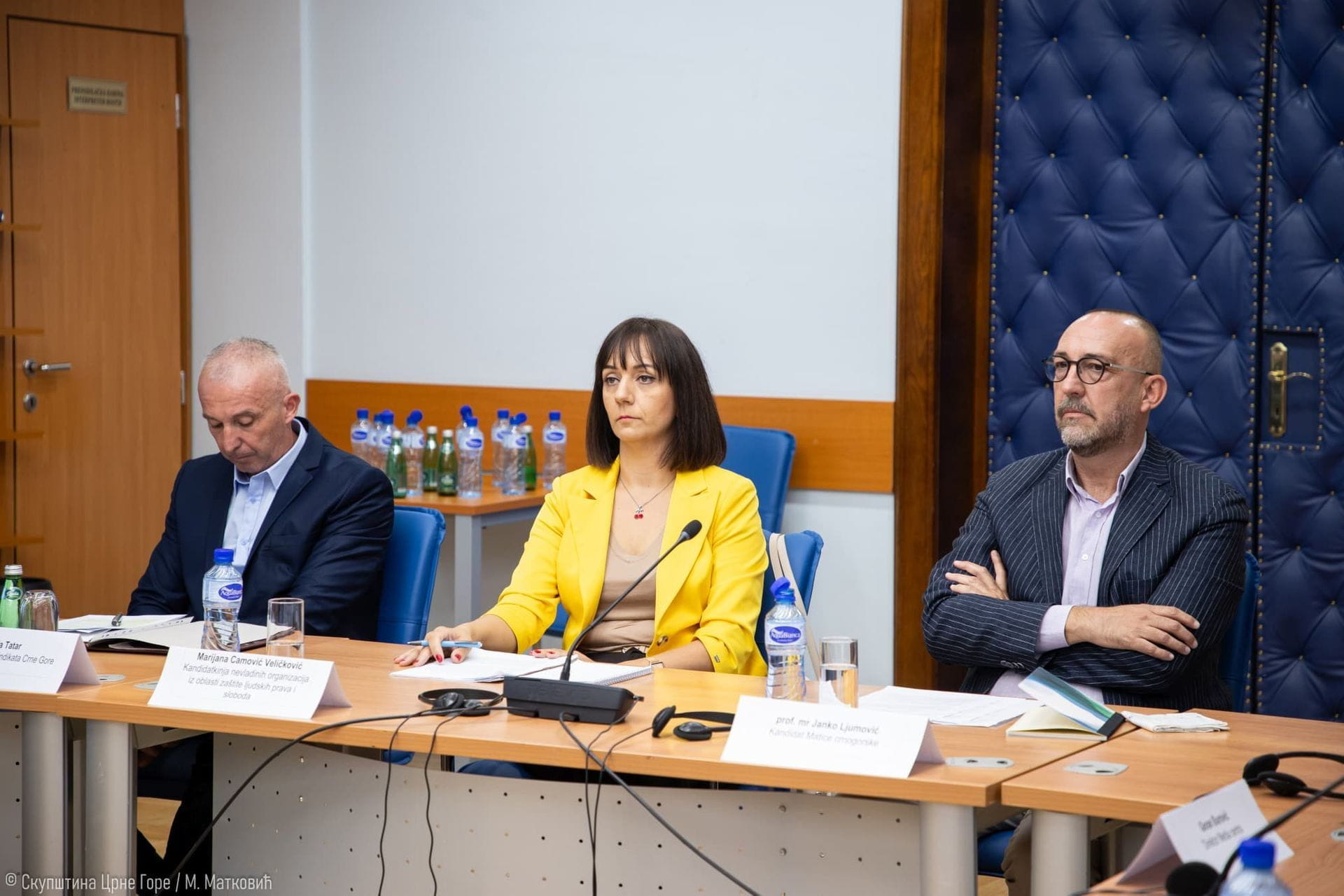
At its 49th session, the committee nominated Marijana Camović Veličković, Janko Ljumović, and Nikola Tatar to serve on the Council of RTCG, while Dragoljub Vuković and Niko Martinović were put forward as members of the AVMS Council.
Committee Chair Jelena Nedović stated that the list of proposed candidates would now be sent to the Montenegrin Parliament for final review and a vote.
“The Administrative Committee determines the proposal list, but it is the Parliament that votes on whether the candidates are approved or not,” Nedović explained.
She noted that while Jelena Šušanj was nominated by the Montenegrin PEN Center, priority was given to the candidate of the Montenegrin Academy of Sciences and Arts (CANU), Niko Martinović, based on provisions in the Media Law.
Ljumović: Public Broadcasters Must Lead by Example
During the pre-vote consultation, Janko Ljumović, a professor at the Faculty of Dramatic Arts in Cetinje and nominee of Matica crnogorska, emphasized the vital cultural role of RTCG.
“Throughout my academic and professional career, I’ve been closely tied to RTCG,” said Ljumović. “In my master’s thesis, I explored production and programming aspects of public broadcasting. I believe public broadcasters should embody values and vision beyond what society currently reflects.”
Camović Veličković: Transparency and Accountability Are Lacking
Marijana Camović Veličković, nominated by civil society organizations focused on human rights and freedoms, highlighted her long-standing career in journalism and media advocacy.
“Since 2016, I’ve worked professionally with the Trade Union of Media of Montenegro (SMCG), conducting research and participating in legal reform processes,” she said. “For the past four years, I served on RTCG’s Council, advocating for transparency and representing the public interest.”
She voiced concerns about a lack of responsiveness within the Council, stating that employee complaints often go unheard unless personally brought forward, and criticized the illegal appointment of the current RTCG Director General Boris Raonić, citing a recent court ruling.
Camović Veličković further pointed out irregularities in internal rulebooks, including the Ethical Code and bonus-related regulations, which have been flagged by the State Audit Institution (DRI) for unlawfully increasing executive salaries.
“These salaries appear on the recently published list of the 1,000 highest public-sector incomes in Montenegro. The Ministry of Finance confirmed last month that they were calculated illegally — yet nothing has been done,” she said.
Tatar Calls for Regional Collaboration in Broadcasting
Candidate Nikola Tatar, representing the Confederation of Trade Unions of Montenegro, emphasized his three decades of experience at the Broadcasting Center and his participation in collective bargaining and international labor conferences.
“The public broadcaster should act as a locomotive for the entire media sector. Others should look to RTCG as an example of how things should be done,” said Tatar.
MPs Highlight Integrity, Ask Tough Questions
During the session, MPs posed direct questions to the nominees.
Zoja Bojanić-Lalović of the Democratic Party of Socialists praised Camović Veličković for her integrity and independence, particularly for distancing herself from the Council after the court ruled Raonić’s appointment illegal.
Jelena Kljajević of the Democratic People’s Party asked whether Camović Veličković believed any progress had been made in RTCG operations.
“There have been some technical improvements and studio upgrades,” Camović Veličković acknowledged. “But the building is still in poor condition, despite €4 million reportedly spent. There are some great journalists and programs — but management lacks legitimacy.”
She said she had been the most publicly active Council member and consistently raised her concerns in the media.
Civil Society Support and Political Debate
Nikola Obradović, from the Center for Civic Education (CGO), said Camović Veličković’s nomination — supported by three organizations — reflected her consistent defense of legal standards during her previous mandate.
Goran Đurović, director of Media Center, argued that legal standards for choosing RTCG’s leadership were intentionally lowered — from ten to five years of experience — to allow Raonić’s appointment.
In contrast, Democratic MP Duško Stjepović accused civil society representatives of misusing procedural rules, warning them to respect parliamentary protocols.
Source: Vijesti