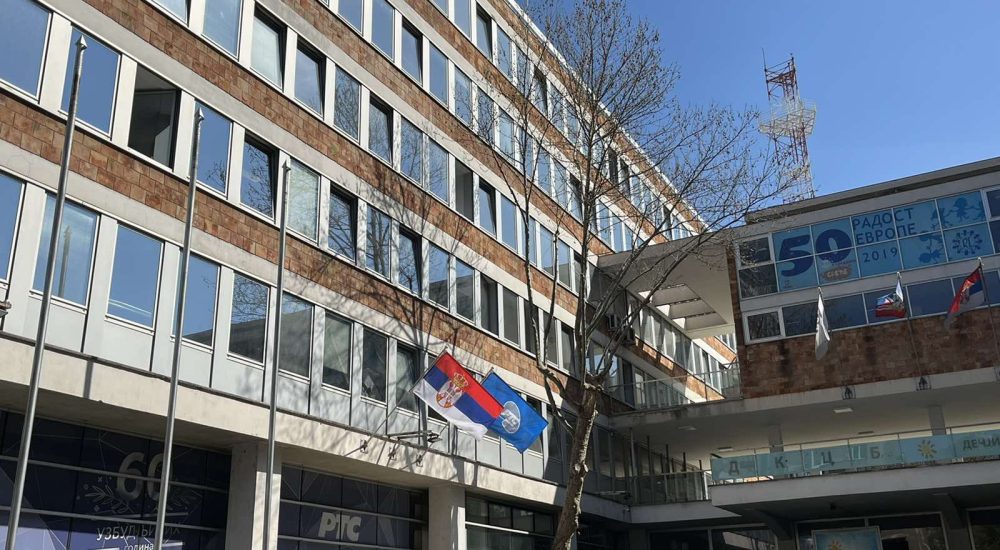
The Serbian state TV (RTS) prime time news bulletin, Dnevnik 2, provides a selective portrayal of political and social reality, so although the public broadcaster formally adheres to a news format and avoids overt “cheerleading,” its overall editorial policy and selection of topics fail to reflect a plurality of views or the diversity of social processes, the Demostat independent research and publishing center said in its report released Wednesday.
The goal of Demostat’s monitoring of Dnevnik 2 during two periods – January and May 2026 – was to identify deviations from the professional standards expected of a public broadcaster and to provide the public, institutions, and relevant actors with findings and recommendations for improving media practices.
Demostat notes that a defining feature of both periods was the high level of activity within the student movement, which remained virtually invisible on state TV.
According to the analysis, most segments on the RTS prime time news bulletin were presented as simple reports without delving into the core of the issues or explaining why they merit a place on a flagship news program – noting, for example, a two-minute segment on fox hunting.
Demostat found that only two reports contained even a mild critical tone, both of which were directed at the European Union. In contrast, there was not a single instance of critical content regarding the domestic situation, the current government, or state institutions during the periods studied.
The analysis further shows that almost every event covered by Dnevnik 2 was also reported by other media outlets, yet coverage of “sensitive” current events was strikingly reduced to a basic reporting format, stripped of any detail regarding the causes or context.
Demostat found that the combination of the segments aired, as well as the topics ignored, reveals a discreet and sophisticated, yet total support for the current government.
Judging by the “Politics” section, political life in Serbia appeared non-existent during both periods, as the bulletin provided no information on the activities of either the ruling or opposition parties, despite deep societal divisions and high political tensions in reality, Demostat said.
Information regarding student and civic activism appeared on only two dates. On January 27, less than 30 seconds were dedicated to an announcement of a planned protest for May 23. On May 23 itself, three minutes were allocated to a much larger and more organized rally at Belgrade’s Slavija Square, but the report failed to address the underlying causes or the demands of the protesters.
Demostat added that the Serbian state TV (RTS) failed to mention even once that nationwide rail traffic had been completely suspended on May 23.
The analysis concludes that Dnevnik 2 functions predominantly as a platform for recounting daily events and broadcasting statements from officials, with analytical approaches being rare.
Most segments are reduced to brief reports lacking broader social, political, or economic context, which Demostat argues makes it difficult for citizens to grasp the significance of the events being reported.
Source: N1