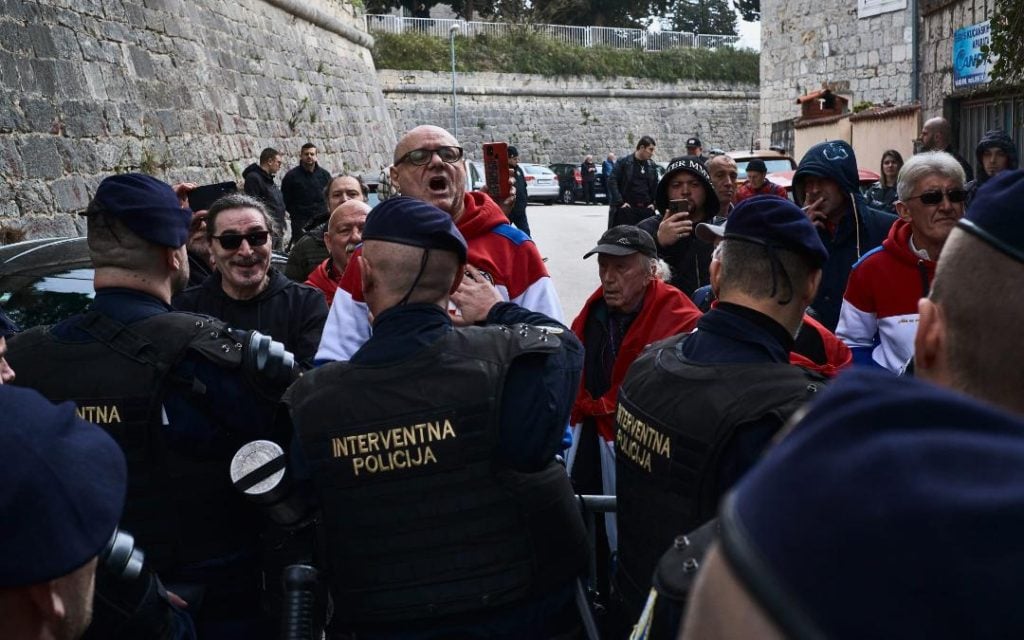
Police did not allow far-right extremists to protest directly in front of the house of the parents of Novosti columnist Boris Dežulović, but they carried it out about a hundred meters away, shouting insults, threats, and hate speech in front of around fifty police officers.
Split police prevented members of the Autochthonous Croatian Party of Rights from holding a protest on Saturday morning directly in front of the house of Dežulović’s parents, but they did not stop them from gathering about a hundred meters away, just around the corner, where for about 45 minutes they shouted insults, threats, and hate speech directed at Dežulović and journalists they recognized: Danka Derifaj, Viktor Ivančić, Ante Tomić and the president of the Croatian Journalists’ Association, Hrvoje Zovko.
In effect, the police order for A-HSP to protest elsewhere failed: although the Ministry of the Interior deployed around fifty riot and regular police officers and a drone, pro-Ustaša extremists achieved their aim—by shouting threats and hate speech in central Split, they disturbed Dežulović’s parents and the entire neighborhood, as their yelling could be clearly heard far beyond it.
The police order did not achieve its purpose despite significant engagement. All four road and pedestrian access points to the house were blocked as early as 8 a.m., two and a half hours before the announced protest, and a police drone monitored the area. Riot police equipped with crowd-control gear set up metal barriers on all approaches, while around ten plainclothes officers stood in front of the house.

This dramatic scene contrasted grotesquely with the sight of Dežulović’s frail 88-year-old mother slowly stepping out of the house, leaning on two walking sticks, asking: “My God, what is this…?” Shortly after, his 86-year-old father returned from the Split market pulling a shopping cart: “Where was I? Well, who’s going to buy bread?”
Police officers, polite but firm, allowed passersby through until about an hour before the protest, but around 9:30 a.m. access was restricted to journalists with press credentials—resulting in local journalist Ante Tešija being turned away as he had not brought his.
“I haven’t taken out my press card in thirty years,” joked Dežulović’s colleague Viktor Ivančić, who came to support him along with others, including his wife and former editor-in-chief of Feral Tribune, Heni Erceg.
While residents gathered nearby in solidarity with the respected journalist and writer—including photojournalist Feđa Klarić, writers Nebojša Lujanović and Edi Matić, and politicians Ivica and Marijana Puljak and Bojan Ivošević—around fifteen A-HSP members gathered in a nearby café. At 11 a.m., they approached a police barricade about 100 meters from the house, where riot police stopped them, but did not prevent them from shouting insults, threats, and falsehoods for 45 minutes.
A-HSP president Dražen Keleminec and party member Alin Kavur attempted to climb over the barricade but were stopped by police. Other protesters got in officers’ faces, accused them of protecting “communists” and “traitors,” and urged them to disobey orders. The police remained calm.
Keleminec and Kavur were the loudest, shouting about alleged “communists” and “Croatian traitors.” They spread false claims about Dežulović, including that he entered Vukovar in 1991 with the Yugoslav People’s Army, which they used to justify insults.
At one point, Keleminec recognized journalist Danka Derifaj and began shouting insults at her. She later told Novosti she would likely file a criminal complaint due to threats. Protesters also targeted journalists Ante Tomić and Viktor Ivančić.
Meanwhile, about thirty citizens held a counter-protest, singing songs such as “Marjane, Marjane,” “This Is My Land,” and “Dalmatia in My Eye.” Police did not allow them to approach the house either, so they gathered on the opposite side of the extremist group.
Keleminec ended the protest with nationalist slogans including “God and Croats,” “Croatia for Croats,” and “For the Homeland Ready,” followed by a prayer and the playing of the song “Čavoglave.” He announced plans to protest at the U.S. Embassy but then said they would return later to Dežulović’s parents’ house.
A police spokesperson on site stated officers would remain as long as necessary.
After the group left, Dežulović told journalists this was not a protest but hate speech and threats.

“If anything good can come of this, it is a precedent that no one should be allowed to protest in front of anyone’s private home. Everyone has the right to public protest, and no one has to agree with what I write, but protests should not take place in front of private homes,” he said.
He added he would respond to lies through his writing:
“There is a way. I write. I publish what I think—and I suggest Keleminec do the same.”
Hrvoje Zovko also commented:
“This was a scandalous incitement attack by a miserable group of extremists, enemies of Croatia, targeting Boris Dežulović and journalists. This should not have happened. No one has the right to harass people. Everyone has the right to protest publicly, but it is unacceptable to protest in front of private homes.”
He announced that the Croatian Journalists’ Association would push for a ban on such protests:
“Dežulović has done nothing to deserve this. This undermines his right to freedom of expression.”
Zovko also addressed threats against journalists, saying the Association would consider further steps, but that institutions should react first:
“Because today it’s us, tomorrow it could be someone else.”