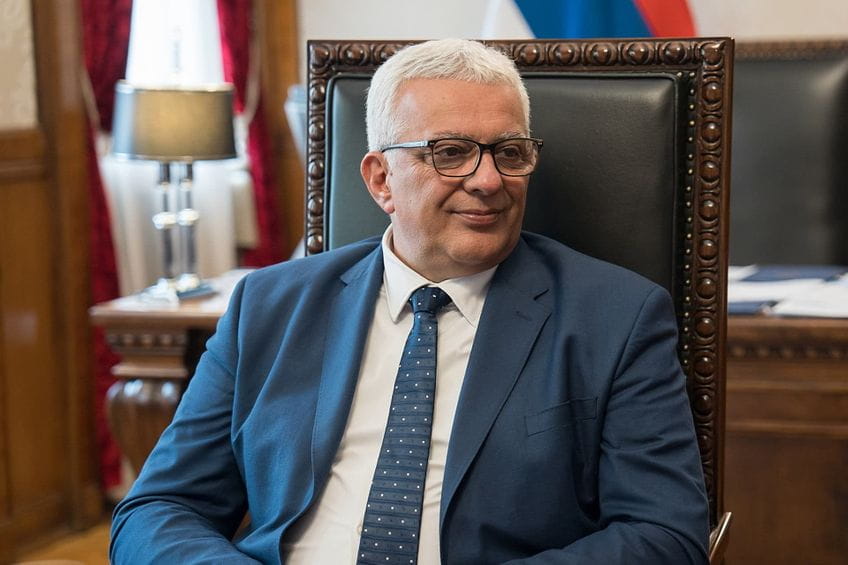
NGOs active in the field of media submitted today an Initiative to the President of the Parliament of Montenegro to contribute to the implementation of media laws and the election of members of the Council of the Agency for AVM Services.
Media-focused NGOs have called on the President of Parliament, for the fourth time, to launch a public call for the appointment of two members of the Council of the Agency for Audiovisual Media Services (AVMS), so that the Law on Audiovisual Media Services can finally be implemented.
The NGOs urge the President of Parliament to end the obstruction of the implementation of the Law on Audiovisual Media Services, which has lasted for more than a year. They warn that the irresponsible conduct of the parliamentary majority he leads could result in the reopening of Chapter 10 (Information Society and Media), which was provisionally closed at the end of last year.
It should be recalled that in June 2024, during the process of securing a positive IBAR, media laws were adopted with the involvement and praise of civil society and the support of the opposition. At that time, the parliamentary majority, led by the President of Parliament, supported them unanimously. The only criticism from civil society and the opposition related to the lowering of requirements for the appointment of the Director-General of RTCG – from 10 to 5 years of professional experience – which was introduced at the last minute by Prime Minister Milojko Spajić, clearly to ensure the reappointment of the same director, despite two final court rulings confirming his previous appointments were unlawful, and a first-instance ruling against a third. This remains a serious political and legal compromise. Still, thanks to the adoption of the new media laws, Chapter 10 was provisionally closed at the end of last year.
The NGOs remind the President of Parliament that, in line with the law, he was required to issue a call for the election of two Council members in June 2024. However, the first public call was launched only on December 10, 2024. On January 24, 2025, the President annulled that call, citing a so-called technical error, allegedly based on an NGO initiative – a move that was clearly forced and legally unfounded. A second call was issued on January 30, 2025, following reactions from civil society and the EU, but in April the Administrative Committee unlawfully annulled it, citing unclear forms – even though those forms had been their own decision.
The European Commission and the European Parliament, in their reports, explicitly noted this delay and obstruction. It is clear that this is being done with the intention of entering into a process of changing the appointment procedures for the AVMS and RTCG Councils, all in order for the ruling majority to maintain political control over institutions that, by law and European standards, must be independent. Ironically, this is the same model of appointing politically loyal members once used by DPS – a practice that the current ruling parties, then in opposition, criticized along with civil society.
Under EU pressure, a third public call was finally issued on May 13, 2025. After document verification, candidates Dragoljub Vuković (NGO) and Niko Martinović (CANU) met the requirements. Instead of being appointed, however, a so-called “consultative hearing” was held – a procedure not provided for in the law – which NGOs highlighted as unlawful. Subsequently, in the plenary session, the majority abstained, once again preventing the filling of Council vacancies. In this way, the ruling majority blocked the appointment process for a third time.
As a result, the AVMS Council is operating with only three out of five members, meaning that all decisions can be made only unanimously and under enormous pressure. This blockade directly undermines the institution’s ability to respond to the most serious cases in media market regulation, including banning broadcasts from Serbia that deny Montenegrin identity, insult minorities, or spread hate speech against those disfavored by the ruling majority in Montenegro.
The NGOs also reminded the President of Parliament that in early October he must announce a new call for a Council member from among the universities, since the law requires the call to be published six months before the mandate expires.
The NGOs informed the President of Parliament that this Initiative will also be communicated to the EU Delegation in Montenegro as well as to EU institutions in Brussels.
“Should Chapter 10 be reopened, the responsibility for slowing down Montenegro’s EU integration and bringing new humiliation to the country before its partners will rest with you, as President of Parliament and leader of NSD, together with your colleagues in the parliamentary majority – Milojko Spajić, Milan Knežević, Aleksa Bečić, Vladimir Joković, Ervin Ibrahimović, and Nik Đeljošaj,” the letter states.
Signatories:
Goran Đurović, Media Center
Olivera Nikolić, Media Institute of Montenegro (IMCG)
Daliborka Uljarević, Centre for Civic Education (CCE)
Milka Tadić Mijović, Centre for Investigative Journalism (CIN-CG)
Mila Radulović, Association of Professional Journalists of Montenegro
Mustafa Canka, NGO “Ul Info”
Zdravko Janjušević, Bijelo Polje Democratic Center
Željko Đukić, NGO Multimedial Montenegro
Nataša Nelević, NOVA – Center for Feminist Culture
Muamera Muslić, NGO Đakomo Adriatic
Boris Nedović, NVU Centre of the North
Radomir Petrić, NVU Sua Sponte Bar
Source: CGO