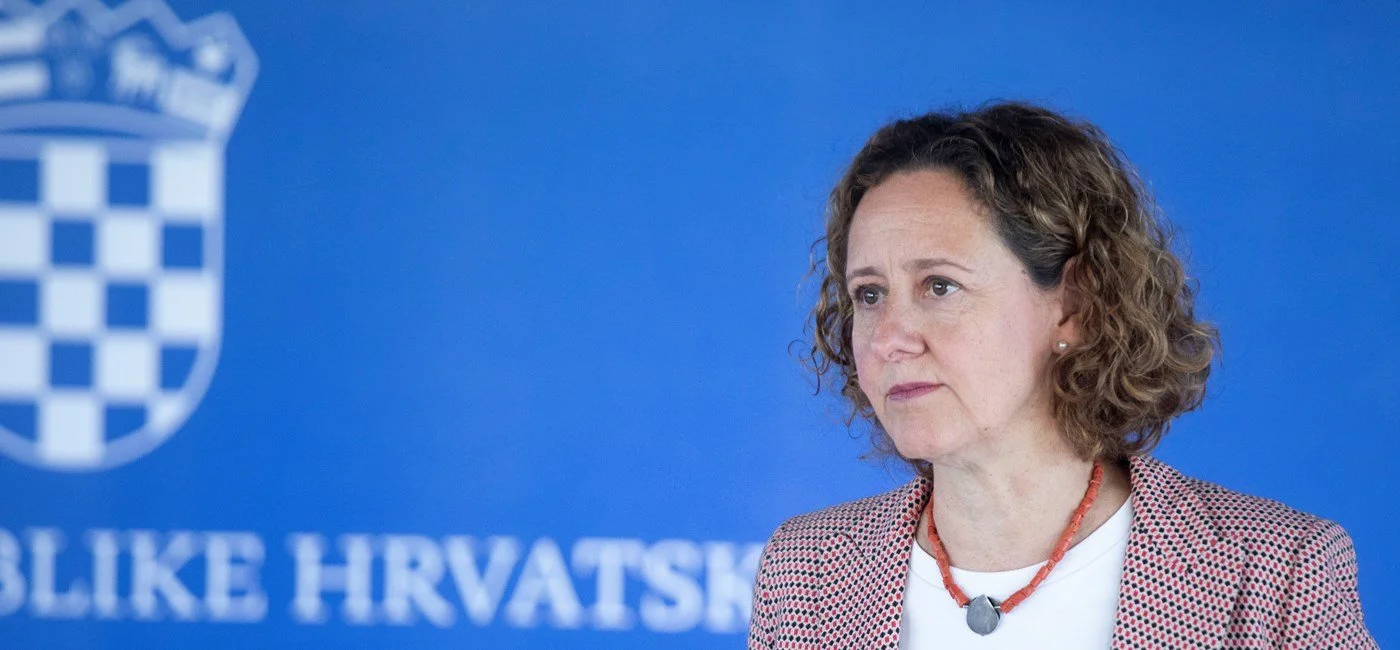
Marking World Press Freedom Day, Minister of Culture and Media Nina Obuljen Koržinek stated that “the latest data on the state of media freedom in Croatia are encouraging and indicate visible progress.” In contrast, Croatian Journalists’ Association (CJA) President Hrvoje Zovko responded: “We do not share the Minister’s assessment of visible progress. On the contrary, we believe that the state of media freedom remains deeply concerning.” An article by Nives Đerek, published by the investigative outlet Oštro, argues that Croatia’s improved position in international media freedom rankings does not reflect the reality on the ground, where journalists continue to face daily pressures, precarious working conditions and political interference in editorial independence.
Speaking on the occasion of World Press Freedom Day, Minister Obuljen Koržinek pointed to several government initiatives as evidence of progress, including measures against SLAPP lawsuits, initiatives to improve journalists’ safety, the launch of the national fact-checking platform “Točno tako” (“Exactly Right”), and the publication of data on media ownership and financing.
However, Hrvoje Zovko told Raskrinkavanje that such claims are difficult to reconcile with journalists’ everyday experience. According to him, judicial pressure, economic insecurity, political influence and self-censorship remain serious problems. Although issues such as SLAPP lawsuits and journalists’ safety have finally reached the institutional agenda—something that was not the case just a few years ago—he believes this is still far from representing genuine progress.
“We do not share the Minister’s assessment of visible progress. On the contrary, we believe that the state of media freedom remains deeply concerning,” Zovko said.
A similar conclusion was reached by the Media Freedom Rapid Response (MFRR) mission in its June 2025 report on Croatia. The mission found a significant gap between the government’s perception of media freedom and the experiences of journalists working in the field. While acknowledging certain improvements, it concluded that measures to protect media freedom remain insufficient and inconsistently implemented, warning that the space for free and independent journalism could shrink further unless comprehensive reforms are carried out.
The Croatian Government also highlighted that Reporters Without Borders (RSF) had moved Croatia from 60th to 53rd place in its World Press Freedom Index.
Zovko stressed, however, that a country’s position in international rankings does not necessarily reflect journalists’ day-to-day working conditions, the pressures they face, or the quality of their employment. He also noted that Croatia’s RSF ranking has fluctuated considerably in recent years, while the problems repeatedly highlighted by journalists have largely remained unchanged. Moreover, RSF continues to classify media freedom in Croatia as “problematic.”
Lawsuits Against Journalists
Among the government’s positive achievements, Minister Obuljen Koržinek highlighted initiatives aimed at tackling SLAPP lawsuits—strategic lawsuits intended to financially and psychologically exhaust journalists, activists and other participants in public debate, discouraging them from reporting on matters of public interest.
The Croatian Government decided to extend the protections provided by the European Anti-SLAPP Directive to domestic cases, not only cross-border ones, a move welcomed by the MFRR. Nevertheless, the report concludes that SLAPP lawsuits remain a systemic threat. Politicians, public officials, businesspeople and judges continue to sue journalists, while critical reporting on the judiciary is, according to the report, almost routinely met with retaliatory legal action.
Zovko echoed these concerns, recalling that the CJA had spent years working to ensure that SLAPP lawsuits were recognised as a major public issue. He warned that such lawsuits are brought by individuals “with enough money and time to wear down journalists and media outlets through lengthy court proceedings, intimidate them and attempt to impose censorship on certain topics.”
While awareness of the harmful effects of SLAPP lawsuits has increased compared to several years ago, he argued that the scale of the problem has not diminished.
“Croatia remains a small country with very large lawsuits. Recently, for the third time in the past five years, the winner of the European award for the biggest SLAPP litigant came from Croatia—this time it was Ivan Marković, President of the County Court in Zadar. That fact alone says a great deal about the situation we are facing,” Zovko said.
Financial and Political Pressure
The MFRR report also addressed political pressure on media outlets reporting critically on those in power. It cited the example of Novosti, the weekly newspaper of Croatia’s Serbian national minority, whose funding from the Council for National Minorities was reduced by 35 percent after the governing coalition partner, the Homeland Movement (Domovinski pokret), openly called for the newspaper to be shut down.
Minister Obuljen Koržinek told the European delegation that the Council for National Minorities is an independent body and that the funding decision fell within its legal competence. However, the MFRR noted that the decision was adopted shortly before local elections, raising serious concerns about its independence.
Speaking to Raskrinkavanje, Zovko also referred to what he described as the Homeland Movement’s “continuous attacks on the media,” pointing out that the party has publicly celebrated the reduction of funding for Novosti. He further argued that the CJA cannot escape the impression that the Prime Minister often behaves like “a kind of editor-in-chief of all Croatian media,” lecturing journalists and editors on how they should perform their work.
Everyday Challenges Remain
Although Croatia has improved its position in the RSF World Press Freedom Index and introduced several institutional measures, journalists’ everyday working reality has not fundamentally changed. The Minister’s assessment is based on certain positive developments—primarily government initiatives—but does not adequately reflect the long-standing structural problems consistently highlighted by journalists and organisations monitoring media freedom.
Lawsuits against journalists remain widespread, working conditions across the sector continue to be unsatisfactory, and political as well as financial pressures continue to burden independent media. By selectively presenting positive indicators while overlooking the broader context, the government’s narrative portrays progress without acknowledging the persistent obstacles to media freedom. For this reason, Raskrinkavanje concludes that the Minister’s claim of “visible progress” presents a one-sided picture of the current state of media freedom in Croatia.
The Ministry of Culture and Media did not respond to Raskrinkavanje‘s request for comment. Should a response be received, it will be published at a later date.