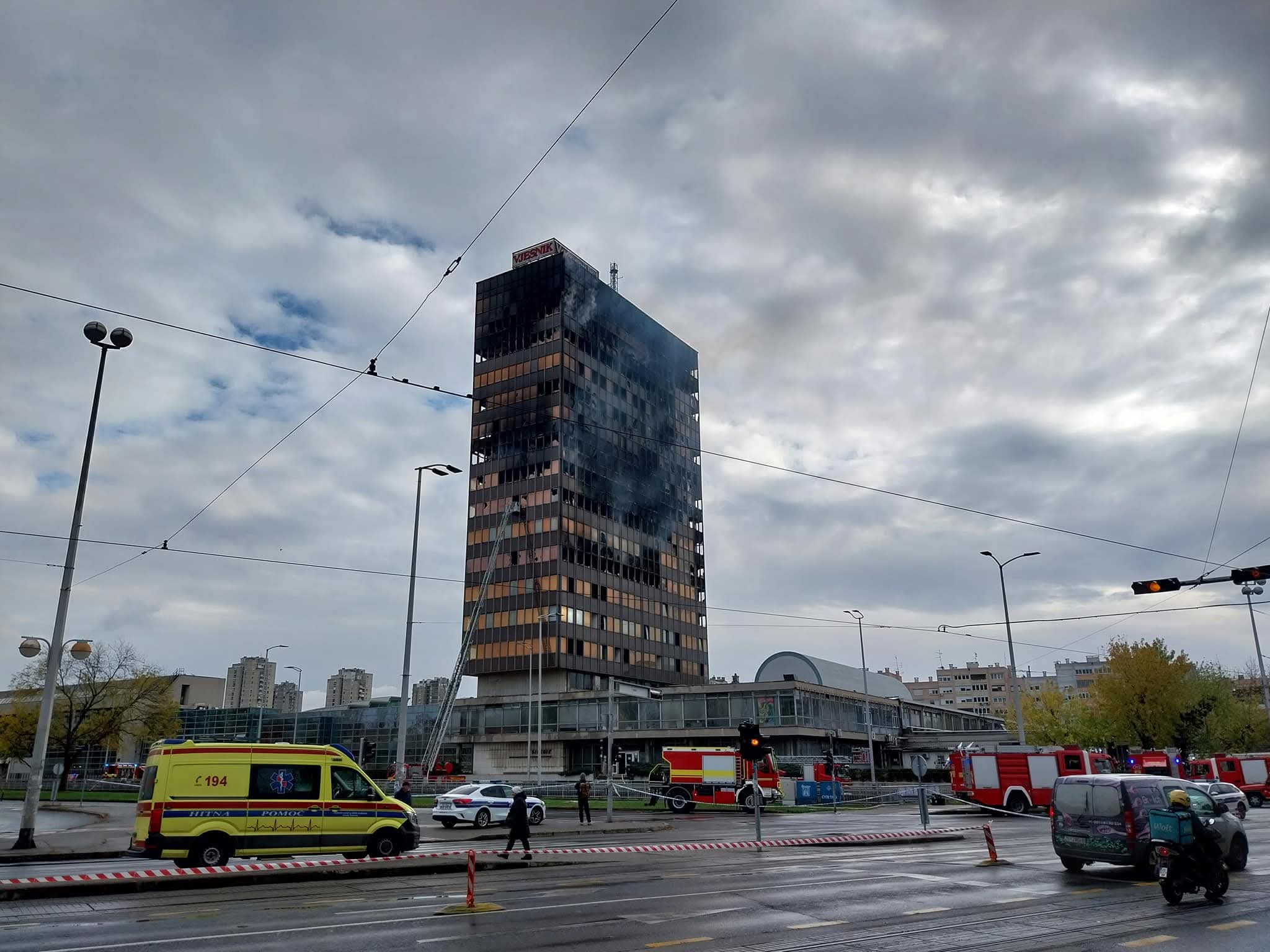
The entry into force of the European Media Freedom Act (EMFA), state subsidies for the distribution of print media, the granting of new broadcasting concessions to Nova TV and RTL 2, the fire at the Vjesnik tower, and the closure of the weekly Globus were the key events that marked the Croatian media landscape in 2025.
The European Media Freedom Act (EMFA), an EU regulation aimed at protecting media independence, pluralism, and transparency across the European Union, entered into force on 8 August. The law governing its implementation was adopted at the end of November, with the Ministry of Culture and Media explaining that it represented a legislative step towards alignment with new European standards for media protection.
“The emphasis has been placed on establishing mechanisms that will ensure transparency of media ownership and financing, prevent undue influence, and protect editorial independence,” the Ministry stated. A key element in achieving these objectives is the establishment of a new regulatory body with expanded powers, unifying regulatory oversight of the entire media sector in Croatia for the first time.
This new body is the Media Agency, the successor to the Agency for Electronic Media, whose existing competences have been expanded. Its responsibilities will now include granting and revoking broadcasting concessions, overseeing compliance with programme principles and media pluralism, preventing unlawful concentration, and—of particular importance—supervising the appointment procedures of governing bodies of public media services: Croatian Radiotelevision (HRT) and the Croatian News Agency (Hina).
During the public consultation on the draft law, as many as 144 comments were submitted, most notably by the Croatian Journalists’ Association (HND) and the Trade Union of Croatian Journalists (SNH). Both organisations expressed their opposition to the law, arguing that the “state of affairs on the ground” could not be resolved through legislation offering only partial solutions. They warned that the problem of respecting editorial independence remained unresolved, as media statutes were not functioning in practice and newsroom autonomy was not being respected. They also assessed that the state still lacked solutions for concealed media ownership and for state advertising.
HND and SNH—an argument also taken up by the opposition—emphasised that the European Media Freedom Act requires “full independence of regulatory bodies” from political influence, arguing that the new law fails to address political influence over the appointment of directors and governing bodies of public media services.
“The management of HRT, the Agency for Electronic Media, and Hina is elected by Parliament by a simple majority. That is direct political influence,” stated MP Urša Raukar Gamulin (Možemo).
Distribution of Print Media as a Service of General Economic Interest
Some observers also view the Croatian Government’s decision as a potential political influence on the media. In early April, the Government declared the distribution of print media a service of general economic interest, thereby securing state funding for this market-unprofitable activity amid the continued decline in print circulation.
After Tisak plus withdrew from newspaper distribution, the Government announced a tender in April for a new distributor, with significant state subsidies. In June, Hrvatska pošta d.d. (Croatian Post) was selected for the job, valued at nearly €140 million over the next five years.
“With this contract, the issue of print media distribution is resolved for the next five years, providing additional support to the development of professional journalism. By signing this contract, Croatia joins the majority of European countries that support print media distribution through similar measures,” the Ministry stated.
The annual value of the contract amounts to €27.68 million including VAT, reduced by publishers’ obligations of €0.15 per distributed copy for daily newspapers and €0.25 for weekly and periodical publications. State funds allocated to support the distribution of Croatian print media publishers—including major groups such as Styria and Hanza Media—are provided within the Ministry of Culture’s expenditures, averaging €14.75 million annually including VAT.
In this way, the state decided this year to subsidise print media distribution and ease the business operations of newspaper publishers.
Television Remains a Profitable Medium in Croatia
Public broadcaster HRT, which is largely funded through licence fees, continued its restructuring plan this year, including staff reductions, without major programme innovations. Leading commercial broadcasters Nova TV and RTL continued operating according to their existing business models.
At the same time, the management of the main commercial television companies faced the expiration of their broadcasting concessions—Nova TV, Doma TV, and RTL 2—which had originally been granted in 2010. Following a public call by the Agency for Electronic Media, both Nova TV and RTL applied within the deadlines and were granted new 20-year concessions.
Although details of the new programme schedules for Nova TV and RTL 2 have not yet been fully presented to the public, their business results indicate that television in Croatia remains a profitable medium.
According to annual reports for the 2024 financial year, the four commercial television broadcasters with national concessions—Nova TV, RTL, CMC (Croatian Music Channel), and Sportska televizija (SPTV)—generated approximately €136 million in revenue and €11 million in profit.
Nova TV recorded the highest revenue and profit, with total revenues of €72 million and a profit of nearly €9 million. RTL Hrvatska generated €60.4 million in revenue and just over €2 million in profit. CMC earned €1.5 million in revenue and around €325,000 in profit, while the publisher of Sportska televizija, HOO TV d.o.o., reported €2.25 million in revenue and €25,739 in profit.
2025 Without Major Changes on the Radio Market
An overview of the media scene in 2025 also shows that there were no significant changes in the radio market.
It is also worth highlighting the results of Reuters’ annual Digital News Report, according to which 77 percent of Croatian citizens primarily consume news via online media. Television follows at 64 percent, social media at 46 percent, and only 21 percent of citizens rely on print media.
Research shows that print media are rapidly losing importance in everyday news consumption.
In the context of their once-dominant status, attention is drawn to the Vjesnik complex in Zagreb, which was completely devastated in a recent fire.
The Vjesnik tower was once the centre of the most powerful newspaper-publishing company in Southeast Europe, which at its peak during the 1980s employed nearly 6,000 people and sold more than 200 million newspaper copies annually. In 1985 alone, more than 267 million copies were printed and over 223 million sold. This meant that the Vjesnik group printed an average of 732,298 and sold 611,599 copies daily.
As the leading media house of the former state, Vjesnik survived through 1986 and 1987, but after ambitious plans in 1988 came the historic year 1989—the beginning of the breakup of Yugoslavia, the aggression against Croatia, and later, through privatisation and transformation, the “fall of the Vjesnik house.”
From the “ashes” of Vjesnik emerged Globus, a political weekly published in Zagreb from 1990, founded by a group of former Vjesnik journalists. Key figures in shaping the magazine included co-owner Ninoslav Pavić, first editor-in-chief Denis Kuljiš, and managing editor Marko Grčić. Although Globus once had a circulation exceeding 100,000 copies, its final issue was published on 24 December this year.
“The decision to discontinue Globus was made after a thorough analysis of market and business circumstances, with the aim of ensuring the long-term provision of quality content and a sustainable publishing model,” Hanza Media announced recently.
By Miroslav Edvin Habek / Hina