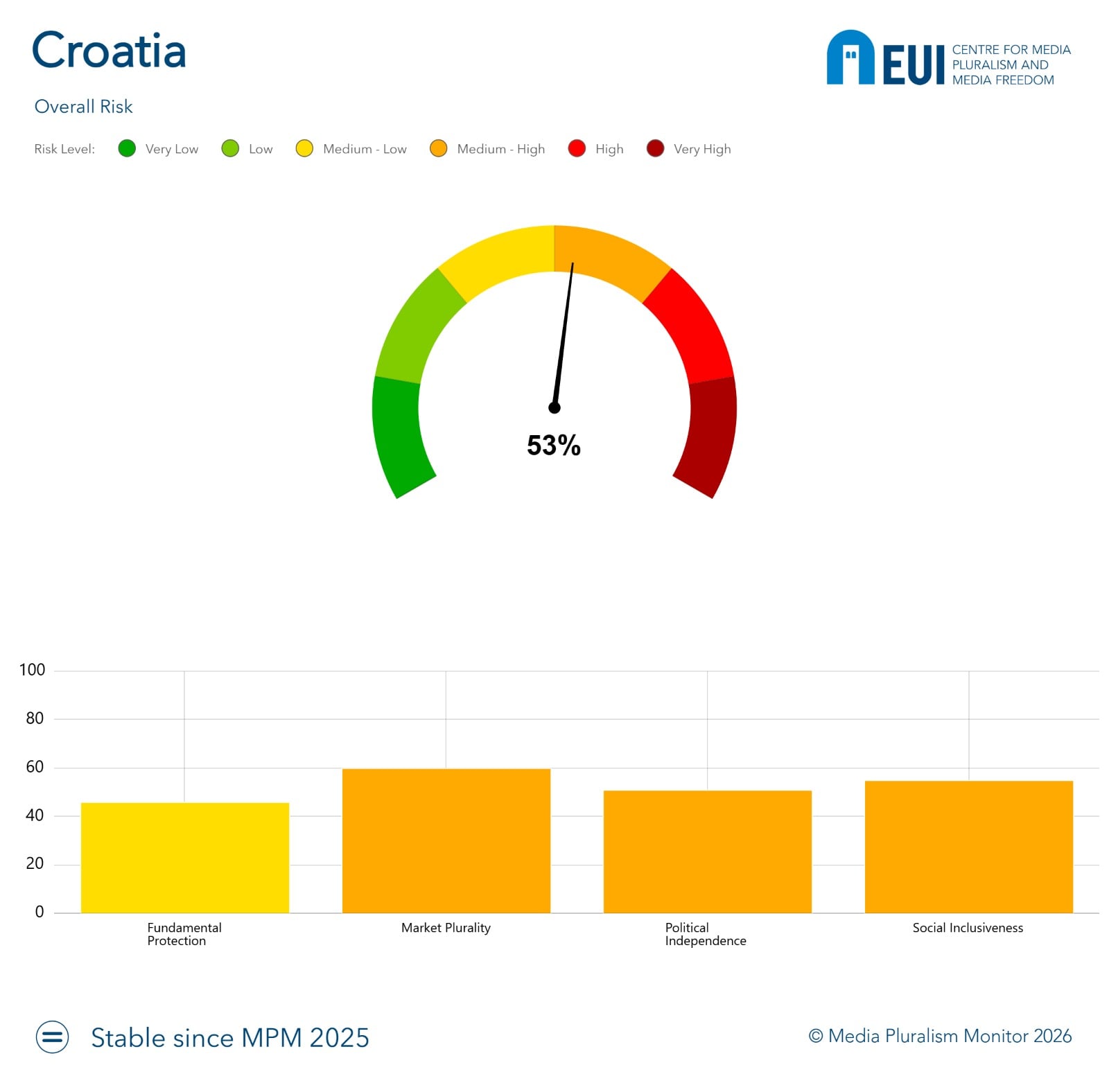
Croatia’s media system underwent several legal and regulatory developments in 2025, primarily linked to the implementation of European regulatory frameworks and new transparency mechanisms, according to the latest 2025 report by the Centre for Media Pluralism and Media Freedom (CMPF).
A significant legal development was the adoption of the Act on the Implementation of the European Media Freedom Act (EMFA) in March 2026, which extends the regulatory mandate of the Agency for Electronic Media and the Council for Electronic Media to the print media sector and introduces a framework for assessing media pluralism and market concentration across sectors. However, the risk assessment presented in this report focuses exclusively on developments in 2025 and therefore does not take the EMFA Implementation Act into account. Amendments to the Media Act and the Electronic Media Act are expected during 2026.
Another major regulatory development was the launch of the Media Ownership and Financing Database in April 2025, funded through the EU Recovery and Resilience Facility. The database collects information on ownership structures, beneficial ownership, revenues and public funding flows. In the field of digital governance, Croatia continued the early-stage implementation of the Digital Services Act (DSA), with the Croatian Regulatory Authority for Network Industries (HAKOM) serving as the national Digital Services Coordinator. However, enforcement mechanisms remained largely non-operational throughout 2025, with no certified trusted flaggers and only a small number of official complaints.
Amendments to the Whistleblower Protection Act (Official Gazette No. 136/25) further expanded reporting channels and strengthened judicial protection mechanisms. At the same time, several structural challenges persisted: the continued use of SLAPP lawsuits and criminal defamation provisions continued to undermine journalists’ autonomy; digital media markets remained highly concentrated and insufficiently regulated; and implementation gaps persisted in areas such as accessibility, media literacy policy coordination and minority-language representation in the media system.
Fundamental Protection
The Fundamental Protection area was assessed as presenting a medium-to-low risk. Key findings include:
- The continued misuse of criminal provisions on insult and defamation (Articles 147–149 of the Criminal Code), alongside significant SLAPP lawsuits targeting media actors.
- Limited implementation of the Digital Services Act, with Croatia’s Digital Services Coordinator receiving only a small number of complaints and certifying no trusted flaggers.
- Amendments to the Whistleblower Protection Act expanded reporting channels to the police and the State Attorney’s Office and introduced expedited court procedures.
- Threats and harassment against journalists continued in practice, while job insecurity and precarious working conditions among freelance journalists remained widespread.
Market Plurality
The Market Plurality area was assessed as presenting a medium-to-high risk. Key findings include:
- The launch of the Media Ownership and Financing Database in April 2025 improved public access to information on ownership structures and financial flows.
- The adoption of the EMFA Implementation Act (Official Gazette No. 27/26) in March 2026 extended regulatory oversight to the print media sector.
- Market concentration remained extremely high in the audiovisual sector and largely unregulated in digital advertising and online news distribution.
- Negotiations between publishers’ associations, including UNIP, and global digital platforms continued, but agreements on financial compensation remain undisclosed.
Political Independence
The Political Independence area was also assessed as presenting a medium-to-high risk. Key findings include:
- No major legislative reforms were adopted during the reporting period, while existing safeguards under the Conflict of Interest Prevention Act (Official Gazette No. 143/21) formally remain in force.
- Concerns persist regarding the capacity and powers of the Commission for the Prevention of Conflicts of Interest.
- The governance structures of the Croatian Radiotelevision (HRT) and the Croatian News Agency (HINA), including parliamentary appointment procedures, continue to raise concerns about political influence.
- The report also notes increased direct political pressure on minority media outlets and on the mechanisms through which they are funded.
Source: Centre for Media Pluralism and Media Freedom (CMPF).